
Lyon, France
November 6-8, 2026
Epoqu’auto
Époqu’auto, organized by a club of enthusiasts, the 3A Club (Old Cars Amateurs), continues to grow. In 2026, an additional hall brought the total area to nearly 100,000 m², accommodating more than 1,000 exhibitors, dealers (cars, parts, and accessories), publishers, artists, and artisans, as well as 220 brand clubs, including 20 new ones! Several hundred cars of all ages and categories were on display, including several themed sections celebrating specific makes and models.


This year, the 2 CV took center stage on the poster, while other exhibitions were dedicated to Bugatti, Voisin, Fiat, BMW, Shelby, and Formula 2 for the Autodiva competition exhibition. The public turned out in force, with nearly 120,000 visitors over the three days. Dates have already been set for the 48th edition, November 5–7, 2027, once again at Eurexpo Lyon.


At its booth on the Place des Lumieres, the 3A Club showcased several locally produced vehicles. Best known for its truck production, Berliet also manufactured cars such as this large 1911 Berliet 22 HP sedan. In 1955, the famous French race car driver Louis Rosier considered becoming a car manufacturer after ending his racing career. That same year, he commissioned an elegant coupe based on the mechanical components of a Renault Fregate. The reworked 2-liter 4-cylinder engine produced 95 hp, a respectable amount of power in the mid-1950s. Unfortunately, Louis Rosier died on October 29, 1956, as a result of an accident at the Linas-Montlhery racetrack on October 7, bringing the project to an end.


Less ambitious, the Marsonetto 1600 GT, unveiled at the 1968 Paris Motor Show, was built by a Lyon-based coachbuilder using a custom chassis and a Renault engine, and remains a one-off.
2CV, Limited Editions, 50 Years of Colors
Featured on the show’s poster, the 2CV SPOT is celebrating its 50th anniversary, an opportunity to look back at the history of the special editions of this popular little Citroen. As soon as visitors entered the show through the “Place des Lumieres”, this 2 CV SPOT stood alongside the electric 2 CV Concept, which had just been unveiled at the recent Paris Motor Show (October 2026) and which fairly faithfully recreates the 2 CV’s design language in a modernized interpretation. The production version is expected in 2028. Initially basic and popular, the 2CV has become, over the years, a true fashion statement.


In 1976, Citroen launched the 2CV SPOT, a special edition designed by Serge Gevin that stood out for its two-tone color scheme, Tenere orange and Meije white. The 1,800 units offered sold out in one week. In the fall of 1980, Citroen launched the 2 CV Charleston, also designed by Serge Gevin, in a striking burgundy and black color scheme. Originally planned for a limited run of just 8,000 units, it proved so successful that Citroen ultimately decided to continue mass production starting in 1981, and the Charleston remained in the lineup until production of the 2 CV ceased in 1990.


Although other color combinations were offered later, only the first 8,000 units constitute the true limited edition, and for the public, “Charleston” is synonymous with burgundy and black. Following the success of the Charleston, Citroen launched a limited edition nearly every year for almost a decade, often in connection with partnerships or events. In 1981, the 2CV 007 paid homage to the James Bond film *For Your Eyes Only*, in which Roger Moore drives a yellow 2CV in a spectacular stunt. Produced in a limited run of just 700 units, it featured the same color as the car in the film and bore the inscription “007” on the doors, hood, and trunk.


In 1983 and 1984, Citroen sponsored the France 3 sailboat competing in the America’s Cup, leading to the creation of the 2 CV France 3. Produced in a run of 2,000 units each year, it stood out for its White Meije paint finish and blue accents. In 1985 and 1986, Citroen offered three series of the 2 CV Dolly, once again designed by Serge Gevin. Based on the 2 CV 6 Special, the Dolly, of which approximately 6,000 were produced, was available in seven two-tone variants.


The Cocorico, introduced in 1986, featured blue, white, and red for the French market, along with a denim-style interior. The Perrier, produced in 1988 and 1989, was intended for the Belgian market and incorporated the Perrier brand’s visual identity.


The Cocorico and Perrier series were each produced in a run of 1,000 units. This extensive selection is rounded out by the 2 CV Basket, the result of a design school competition. Only two units of this model were produced (the right and the left), and only one has survived, the one on display at Epoqu’auto.


Voisin, from airplanes to cars
A native of the Lyon region, Gabriel Voisin was an aviation pioneer in the early 20th century and played a major role in the growth of military aviation leading up to World War I. In fact, a glider of his design was suspended above the booth. After the war, while retaining the “Avions Voisin” brand, he ventured into automobile production. During the 20-year interwar period, Voisin competed with the prestige brands of the era, Bugatti, Hispano-Suiza, Isotta Fraschini, Bentley, and Rolls-Royce.


About fifteen models, ranging from the C1 of 1920 to the C30 of 1937, illustrate the brand’s brief history. While Gabriel Voisin’s early designs featured fairly classic lines, they often included large trunks mounted on the running boards behind the fenders, and, most notably, his mascot: an Art Deco “winged hen” made of riveted aluminum strips. The architect and urban planner Le Corbusier was one of Voisin’s famous clients and considered his C7 to be a symbol of modernity. Starting in 1926, Voisin models were equipped with a 6-cylinder engine, and gradually Voisin began offering bodies with its characteristic low-slung roof, such as the 1929 C15, which was Gabriel Voisin’s personal car, and the 1933 C22 “Siroco.”


The 1927 Record Car is a one-of-a-kind vehicle equipped with an 8-liter inline-8 engine producing 210 horsepower, designed to break a series of records at the Montlhery racetrack. Inspired by aeronautics, Art Deco, and architectural modernism, Voisin introduced an imposing, aerodynamic aluminum body called the “Aérodyne” for the C25 (1935). The C28 Aerosport took the aerodynamic concept even further with an aluminum pontoon body featuring a sophisticated hydraulic sliding roof. The model on display, which was damaged during World War II, was reconstructed using the original blueprints and numerous recovered body parts.


After World War II, the era of prestige and refinement had passed, and Voisin completely shifted its focus to research on small, lightweight vehicles with the C31 Biscooter, offered in various versions, 2- or 4-seaters and utility models. The C31 enjoyed some success in Spain, where approximately 15,000 units were sold under the name Biscuter. Next to it, the Club Voisin booth displayed a Voisin LA 5 aircraft, a bomber used during World War I.


The Dolce Vita in Fiat
The exhibition begins with an exceptional model, the 1899 Fiat 3.5 HP, the very first automobile sold under the Turin-based brand, of which only four surviving examples have been identified. In the 1920s and 1930s, Fiat marketed luxury models with 6-cylinder engines, such as the 524 Cabrio and the 512 Coloniale. But by the mid-1920s, Fiat had turned its attention to the mass-market car with the 509, the first small-displacement car mass-produced by Fiat. Its successor, the 508, introduced in the early 1930s, surpassed 200,000 units produced and was manufactured in several countries, including France under the Simca brand.


A 509 “Skiff”, a sporty body style inspired by sporty motorboats, featuring the same sheet metal and varnished mahogany, and a 508 S “Coppa d’Oro” showcased the sporty variants of these popular small cars. Another 509 was on display nearby: a replica of the yellow-and-black car driven by comic book hero Gaston Lagaffe, who is returning in new adventures. The first-generation Cinquecento (500) was unveiled on June 15, 1936, in Turin and was quickly nicknamed Topolino (little mouse). Though not very powerful, it was modern and well-designed; the Topolino evolved after the war and remained in production until 1955, with production totaling nearly 600,000 units. The 500C on display is from the latest generation, launched in 1949.


A new generation of rear-engine models took over with the 500 and 600, available in several versions, shown here as the 500 Giardiniera, a small, versatile station wagon, and the family-oriented 600 Multipla. Several other popular models, such as the 850, the 1300 and 1800, and later the 124 and 131, illustrate the evolution of the lineup through the 1970s.


Beyond this mass-market production, Fiat also offered more exclusive coupes and convertibles designed to enhance the brand’s image, such as the 2300 S 6-cylinder coupe (1964) or the small 850 Spider (1970), derived from the 850 “sedan.” The 124 Spider was designed to be sportier and enjoyed a very long production run of nearly 20 years, a rarity for such a model, resulting in nearly 200,000 units produced.


In the late 1960s, Fiat attempted to move upmarket to compete with BMW and Mercedes (the term “premium” hadn’t yet been coined), but while the project was ambitious, limited budgets and numerous constraints resulted in a very classic sedan equipped with a V6. However, Pininfarina went on to develop the very elegant 130 coupe featured in this selection. During the same period, Fiat also offered another, significantly sportier coupe: the Dino, which was also equipped with a V6, but this time, a Ferrari-sourced engine.


A few “youngtimers,” including the mid-engine Fiat X1/9 (1976) and the Barchetta (1999), rounded out this historic selection.


Youngtimers: BMW M3/M4, 40 years of sportiness
Every year, Epoqu’auto features a youngtimers section, and for 2026, an area dedicated to the BMW M3 provided an opportunity to celebrate the 40th anniversary of this sports car icon. Introduced in 1986 to meet Group A racing homologation requirements, the M3 became a massive commercial success (with over 17,000 units sold), giving rise to one of the most iconic sports car lineages. The first generation, based on the two-door E30 3 Series, was equipped with a 200-horsepower inline-four engine, but the Sport Evolution version on display delivered 238 horsepower.


The second generation of the 3 Series (the E36, launched in 1992) was available as a 4-door sedan and a coupe, and it was this version that served as the basis for the M3, this time a standalone model within the lineup. This time, it was powered by BMW’s famous inline-6 engine, initially in a 3.0-liter version, then in a 3.2-liter version delivering 321 hp. Weighing less than 1.5 metric tons, it proved extremely versatile and attracted more than 70,000 buyers. It was introduced in its iconic blue color, as well as in a limited-edition GT version in racing green. The E46 arrived in 2001, still as a 2-door coupe, and its engine gained about 20 hp. The CSL badge, previously seen on the 3.0 coupes, appeared on the E46 M3 for a lighter and more powerful version.


With the E92 launched in 2007, BMW equipped its sports car with a 420-horsepower V8, boosted to 450 horsepower in the M3 GTS, which was displayed in its exclusive orange color. Starting with the following generation, the M3 became a sedan (F80) and the coupe was renamed the M4 (F82). A return to the inline-6, but now twin-turbocharged to deliver 430 horsepower. A limited-edition “M4 DTM” celebrates BMW’s 2016 championship win in the German DTM series, featuring an engine boosted to 500 horsepower, a weight-reduction program, and numerous aerodynamic additions.


Since 2021, the M4 G82 (G80 for the sedan) has continued to feature the 3-liter turbocharged inline-6, but delivers 480 horsepower in the “base” version, 510 horsepower in the M4 Competition variant on display, and even 550 horsepower in the M4 CSL, the sportier version of the coupe. Alongside this dozen or so (grand) touring cars, the M3 area also featured several race cars, notably the M3 E30s, which were a major presence in rallying and hill climbing in the 1980s and 1990s and continue to dominate historic races. BMW has been officially involved in the GT3 category for several years now with the M4 G82, driven notably by Valentino Rossi, one of whose race cars was on display.


Next to these M3s and M4s, a display area showcased another BMW racing legend, the 3.0 CSL “Batmobile” (E9), which racked up titles and victories in the 1970s. The 3.0 coupe was then the pinnacle of the BMW lineup, and the 3.0 CSL road version was released to meet racing homologation requirements. And that’s where we find the M4 G82, which serves as the basis for a very limited series (50 units) named the 3.0 CSL in homage to the “Batmobile.” White with “M” color stripes, meticulous aerodynamics reminiscent of its predecessor, and a 560-chevaux inline-6 engine, this 3.0 CSL is a collector’s item.


The BMW dealership in Lyon showcased another limited-edition BMW (also 50 units) on its adjoining booth: the Skytop, a spectacular convertible unveiled at the Villa d’Este Concours d’Elegance in 2024, based on an M8 Competition.


Bugatti, Excellence in Racing
Founded in 1909 in Molsheim by Ettore Bugatti, Bugatti quickly made a name for itself in the world of auto racing and built an impressive record of racing achievements. The Bugatti exhibition at Epoqu’auto featured 19 models covering virtually the entire range of race cars produced, from the first Type 13 in 1913 to the Type 251 in 1956.


This selection included factory cars and customer models, restored cars, and cars still in their original racing configuration. Each one tells a story of Bugatti’s technical ingenuity and boldness. The Type 13 on display is a 16-valve version from 1922 that raced in England, Australia, and New Zealand until 1945.


The Type 30 (1922) introduced Bugatti’s inline-8 engine and was produced in both racing torpedo body styles and more “civilian” models. In 1923, the Type 32 “Tank” explored an aerodynamic design inspired by an airplane wing with the goal of winning the 1923 ACF Grand Prix in Tours. Bugatti placed one car on the podium, but the other three were forced to retire. Since the car proved unstable at high speeds, the idea was abandoned; the Type 32 would never race again, but it remains one of the most spectacular Bugattis ever built.


The Type 35 is undoubtedly the most famous Bugatti in history. Although it did not win its first race (the 1924 ACF Lyon Grand Prix), it went on to claim nearly 2,000 victories around the world, making it the most successful race car in history. In 1929, the Type 45 was equipped with a 16-cylinder engine, consisting of two supercharged inline 8-cylinder engines. Although the car was powerful (about 250 chevaux), it was also heavy (1,000 kg), and only two were built; they competed in three races, winning two of them.


The Type 57, designed by Jean, Ettore’s son, gave rise to several racing and touring versions, among the most beautiful Bugattis ever made. The 57 S on display (with a lowered chassis), bodied as a two-seater Sport, competed in numerous races in 1937, including the 24 Hours of Le Mans. In 1938, Bugatti mounted a supercharged inline-8 engine from the Type 50 into a lightweight Type 59 chassis. A one-off model (another was built for testing), the 59/50 B won several races in 1939 and claimed one final victory in 1945.


The Type 251 was the last Bugatti race car, unveiled in 1955 for the Formula 1 Championship. Highly innovative with its transversely mounted inline-8 engine (designed by Colombo) positioned in a mid-rear layout (the first Formula 1 car with this architecture), the 251 suffered from a lack of fine-tuning and a limited budget on Bugatti’s part. It competed in the 1956 Grand de France, its only race appearance.


Autodiva, Formula 2
Autodiva (a magazine on the history of auto racing) presents a competition lineup every year, and for 2026, the focus was on the 2-liter European Formula 2 series from 1972 to 1984. In 1972, the introduction of 2-liter engines gave new momentum to the series, allowing an entire generation of drivers to test their skills before moving up to Formula 1. Among them, several French drivers cut their teeth there before shining in F1, such as Rene Arnoux, Patrick Depailler, Jean-Pierre Jabouille, Jean-Pierre Jarier, Jacques Laffite or Didier Pironi.


The dozen or so single-seaters on display illustrate the evolutionary changes, particularly in aerodynamics, over the course of about a decade: rear wings, wraparound front wings, engine cowlings… Major manufacturers and independent teams such as AGS, Chevron, March, and Martini are represented, along with two European champions: the March 742 BMW, in Elf livery, with which Patrick Depailler became European champion in 1974; and the Elf 2 V6 Renault, in Elf and Switzerland livery, behind the wheel of which Jean-Pierre Jabouille in turn became European champion in 1976.


Beyond the racetracks, these single-seaters also excelled in hill climbs, such as the Martini Mk43 in Motul and Primagaz livery, which helped Marcel Tarres become the French Hill Climb Champion. Like other F2s of this generation, it has found a new youth on life in historic races and, in 2026, just won the French Historic Hill Climb Championship title with Nicolas Defix.


Local Racing
One of the racing exhibits highlighted motorsports in the Lyon region, featuring local drivers and regional events, including rallies, circuit races, and hill climbs. The cars on display ranged from the 2015 French champion 2 CV Cross to the 1998 Formula 1 Prost GP AP01 (show car version), including the R5 Maxi Turbo and Julien Saunier’s Porsche 996 GT3 Cup.


The 2004 BMW Z3 GT Coupe and the De Tomaso Pantera made their mark in hill climbs, while the Rondeau M 584 and the Merlin MP 23 distinguished themselves on the track in the hands of regional drivers.
Shelby Village
The Place des Lumieres hosted Shelby Village by Gentleman Car, the exclusive importer and distributor of Shelby vehicles (Shelby Cobra, Cobra Daytona, and GT40) for Europe. This area dedicated to the world of Carroll Shelby will feature Carroll Shelby’s authentic motorhome, two Shelby Cobras, and a Ford GT40, a faithful replica of the 1960s prototype.


Museums and institutions
As is the case every year at Epoqu’auto, several museums and institutions were in attendance.
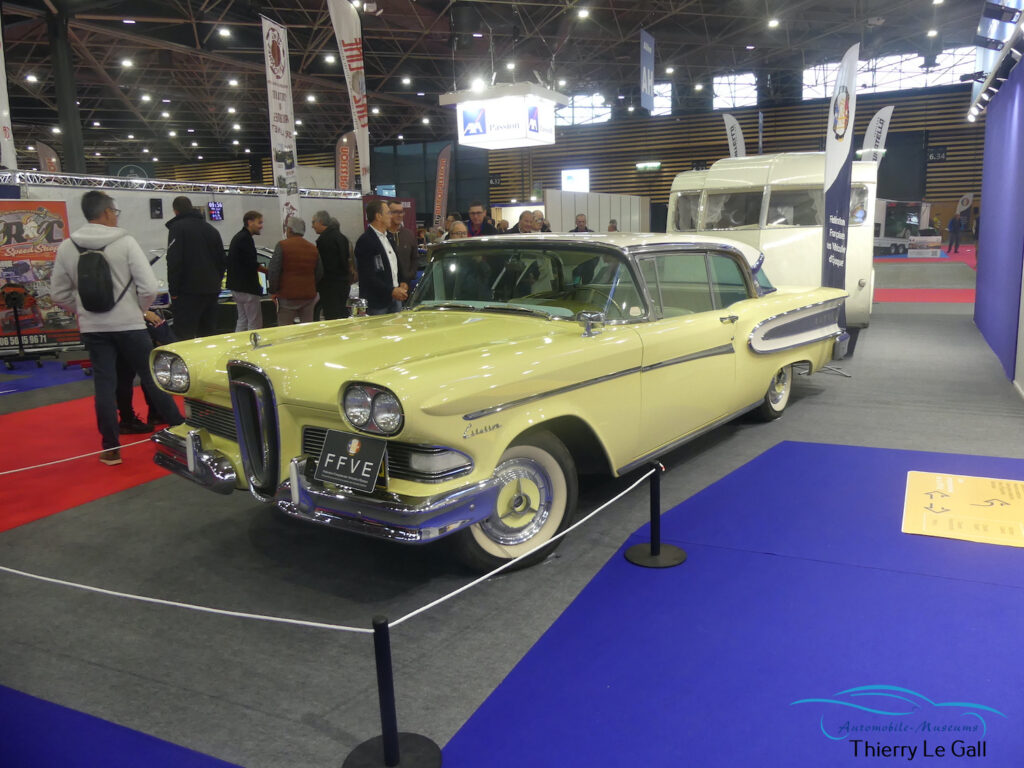
The FFVE (French oldtimer vehicles association) offered its full range of services and exhibited an imposing 1958 Edsel Citation Coupe and its 1961 Henon Maison Blanche Caravan.
Clubs
For the organizers of the Epoqu’auto show, who are themselves avid classic car enthusiasts, brand- and model-specific clubs are a very important part of the exhibition. This year, 220 clubs, including 20 new ones, were in attendance, representing a wide variety of French and international brands. While awaiting the opening of its museum (groundbreaking has taken place, and the opening is now expected in early 2028), Renault “The Originals” (the label for heritage-related activities) brought out several gems from its reserves to celebrate a few anniversaries.
Introduced in 1956 as the successor to the 4CV, the Dauphine turns 70 this year. Sold for over 10 years, more than 2.1 million units were produced. The Ondine aimed for luxury and refinement with an upgraded finish and chrome trim, while the 1093 was a sporty version based on the Dauphine Gordini. The Dauphine also had a successful racing career, culminating in victory at the 1958 Monte Carlo Rally for car No. 65, which was on display at Epoqu’auto. More unusual is an electric Dauphine from 1959, far ahead of its time. However, this was not a Renault production model, but a proposal from an American company that did not enjoy great success, with fewer than 50 units sold. Renault also exhibited the CX-15 prototype, based on the Dauphine platform and intended for aerodynamic studies, boasting a remarkable drag coefficient (Cx) of 0.15 for the 1960s, hence its name.


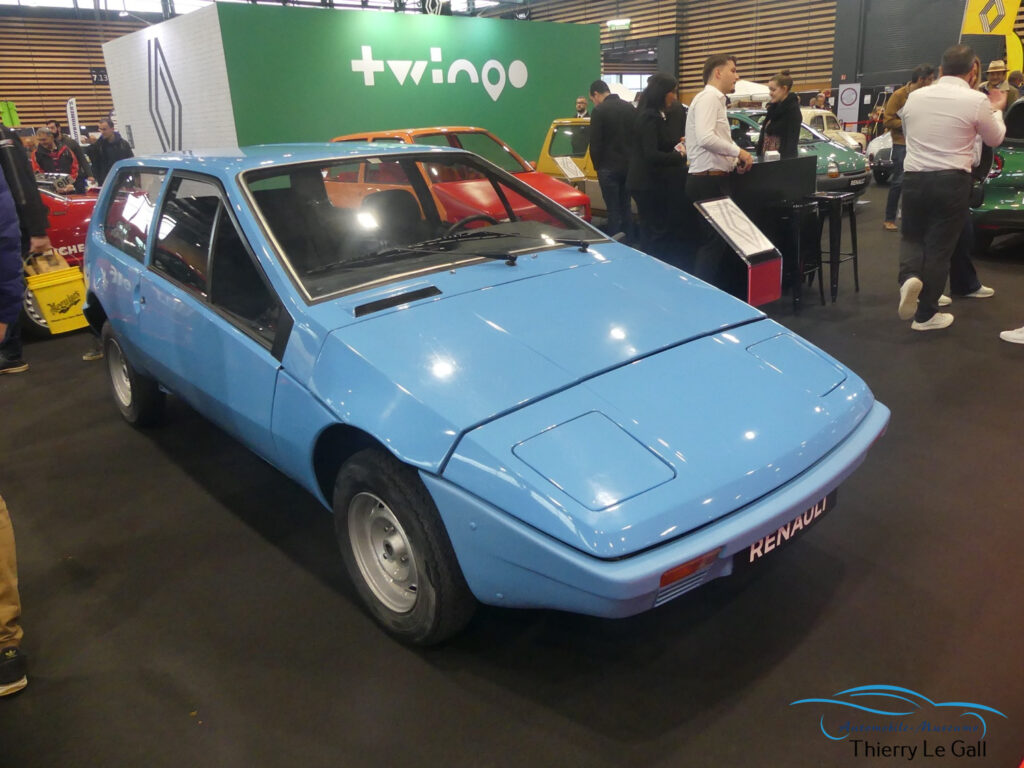
The Renault 14, launched in 1976, is celebrating its 50th anniversary. Despite its unflattering appearance and an advertisement comparing it to a pear, the Renault 14 neared one million units in production. Alongside a production-model R14, Renault displayed a more attractive prototype of a sport station wagon, which unfortunately never made it to production. Also on display were two other interesting prototypes from the VBG (Low-End Vehicle) project dating from 1976 and 1984, a project that would eventually lead to the Twingo.


To mark the 40th anniversary of the R21, which went on sale in 1986, Renault focused instead on the racing versions of its sedan, which competed notably in touring car categories in the late 1980s: Superproduction in 1988, Supertourisme in 1989, and Europacup in 1989 (a one-make series held as a support race for European Grand Prix events). To promote its R21 2.0 Turbo, which was intended to take on German sports sedans, Renault prepared a special version to break the speed record on ice. On February 4, 1988, this one-of-a-kind model reached 246.926 km/h on snow tires on a frozen lake in Sweden.


Renault celebrated a special anniversary at Epoqu’auto: the 20th anniversary of its F1 World Championship (Manufacturers) title, won with Fernando Alonso’s R26, which was on display at the Renault The Originals booth. Gathered around this booth were clubs bringing together enthusiasts of various models, featuring a replica of the Renault Type A, the first Renault built in 1899, a luxurious Renault 40 CV Sport, several Renault 5 Maxi Turbos, a Renault 17 “rally” model, Alpine A110s (both classic and newer models), and A310s, as well as R12s and Dauphine Gordinis for the eponymous club.


Always a strong presence, the Citroen clubs naturally showcased several 2 CVs, a C6 (the 1930s model) in very nice autumnal scenery, a “Rosalie,” and a few sports models, including the Visa Chrono and the BX 16 RS, which had been revised and upgraded by the regional tuning firm Politecnic.


L’Aventure Peugeot is also celebrating several Peugeot anniversaries at the 2026 Epoqu’auto Show, starting with the 90th anniversary of the Peugeot 302, represented by a reproduction of the magnificent Darl’Mat roadster. Darl’Mat was a Parisian Peugeot dealer involved in auto racing, notably the 24 Hours of Le Mans, where he entered his roadster in 1937 and 1938. Twenty years later, at the Paris Motor Show in October 1956, Peugeot launched its 403 convertible, derived from the 403 sedan introduced one year earlier. Known worldwide thanks to television, as it was Inspector Columbo’s car, the Peugeot 403 Cabriolet was produced in just over 2,050 units between 1956 and 1961.


Another convertible was celebrating its anniversary, as the 204 convertible (along with the coupe) was introduced 60 years ago, in 1966. The 204 convertible is displayed alongside the 304 convertible, which would replace it a few years later. Just over 18,000 204 convertibles rolled off the assembly line. Fast-forward another 10 years, and we arrive in 1976, the year Peugeot unveiled the 104 Peugette, a concept car designed by Pininfarina based on a 104 Z. This small roadster celebrated 25 years of collaboration between Peugeot and Pininfarina. With its small 66-chevaux engine and a weight of less than 800 kg, the Peugette could have been a dynamic yet affordable option, but it never made it into mass production.


Continuing with the convertible series, a 1936 301D convertible was presented by “Les Amis des Peugeot 01,” and a 504 convertible by the Amicale 504. Also among the Peugeot model clubs, there was a 604 limousine developed by Heuliez based on the 604 V6. With a wheelbase extended by 62 cm, the total length reached 5.3 m, and 124 units of the car were sold. The model on display had recently undergone a complete restoration.


The Simca Clubs offered an eclectic display, featuring a 1935 Simca Fiat decked out for a wedding, a very ’60s-style 1100 Special, the ever-elegant Bertone 1200 Coupe, and a Chambord whose grille, rear fenders, and chrome accents were inspired by U.S. production models.


Among the prestigious pre-war French brands were Talbot, with a 6-cylinder M67C convertible (1930), and a 1936 Hispano-Suiza K6. Artisanal manufacturers such as Marcadier (Barzoi coupe), Rene Bonnet (later taken over by Matra) with a replica of the 1964 24 Hours of Le Mans Aerojet, and DB with a prototype from the 1957 24 Hours of Le Mans continue to have many enthusiasts in very active clubs.


Studebaker showcased a stunning 1955 Champion coupe, a model that made a name for itself in a more powerful version during the Carrera Panamericana. The Lamborghini Club France exhibited two Miuras, a classic gray one and a vibrant apple-green one, while the Maserati Club showcased a Tipo 26B that competed in Grand Prix races in the late 1920s and a superb 1964 Sebring Coupe, and the Lancia clubs displayed a 1940 Aprilia (1940) to mark the 90th anniversary of the model introduced in 1926, as well as a 1967 Flavia Coupé, a 1967 Fulvia Zagato, and a Fulvia “Fanalone.”


On the British side, the convertible from the Lyon Rolls-Royce Club was fully prepared for a wedding, while the Aston Martin Club (a newcomer to Epoqu’auto) showcased three iconic generations: the DB5 for the ’60s, the V8 Vantage for the ’70s, and the Vanquish Volante for the present day.


Echoing the M3 and CSL exhibition, the BMW Club also displayed two 3.0 CS and CSi coupes, as well as a lovely two-tone 1940 328 roadster. The Porsche Clubs were gathered at a booth featuring several classic sports cars from Stuttgart: the 914/6, 924 (which is celebrating its 50th anniversary this year), 928, and 911.


Car Dealers
Epoqu’auto is also an opportunity to do business or make new contacts, so many classic car dealers make the trip. Several Porsche specialists from the Lyon area were in attendance; “La Villa Rose” showcased a selection of classic and modern models, including the 911 S, 911-996 convertible, and 911-992 GT3 Touring, while LJ Motorsport offered a selection of Turbo, GT3, and convertible models for sale.


A renowned Jaguar specialist, L’Atelier des Coteaux featured an E-Type convertible and an XK 150 roadster, as well as a Porsche 911 2.2L Targa, a BMW 3.0 CSL, a rare Lamborghini Islero, and a small selection of Corvettes. EVO CARS featured a mix of modern supercars, such as the Porsche 911 GT3 RS, 911 Turbo S, and Lamborghini Huracán STO, alongside classic Porsche 911s.


Saga Classic highlighted the “Pagoda” SL convertibles and later models, while Paul’s Classic Cars offered a choice between a Porsche 356, a Mercedes 190 SL roadster, several British roadsters, or meticulously crafted replicas of the Jaguar Type D or Ford GT 40. AMG Sport Garage exhibited a one-of-a-kind model, a restomod based on a 2-liter 911, featuring Turbo Look bodywork and an engine tuned to 300 horsepower, while “Voiture sur Mesure” offered a choice between a Lamborghini Gallardo or Huracán, a Ferrari 328 GTS, a Porsche 911 Carrera convertible, or a BMW 3.0 CS.


As visitors strolled through the aisles, they could admire a Lamborghini Gallardo or a Ferrari 355 GTS at West Motors; a Ferrari 488 Pista Spider at Gatelin; a Porsche 930 Turbo convertible, an Aston Martin DBS “Casino Royale,” or a Ferrari 550 Maranello at Mecanicus; and at Capots Vintage, a Porsche 356, a Jaguar XK 120, or a Facel Vega convertible; at Oldtimer Farm, a lovely trio of a Ferrari Testarossa (1989), TR (1992), and 512 M (1996); and an Aston Martin DB5 Cabriolet at Vintage & Historic Cars.


Auction Houses
Several auction houses active in the automotive world were present at the show. Osenat offered the largest selection, as its auctions were held on-site. This year, the stars of the auction were linked to their former owners, including the 1937 De Soto 6-Cylinder Cabriolet that once belonged to writer and aviation pioneer Antoine de Saint-Exupéry, the Mercedes-Benz 600 formerly owned by French actor Jean-Louis Trintignant, the Peugeot 505 GTi Turbo that belonged to former French President Valery Giscard d’Estaing, and a Citroën 2 CV driven by François Allain in the 2018 Tour Auto.


Many popular cars (2 CV, AMI 6, Traction, including a 1936 convertible, VW Beetle), small sports cars (Alfa Romeo, Alpine, Lancia, Lotus, MG, Triumph), and a few prestigious models (Jaguar XK 150 and E-Type, Maserati Indy, Ferrari Testarossa…). Also worth mentioning were a 1927 Bugatti Type 27 Brescia and a Porsche 911 Speedster “Turbo Look.”


Aguttes presented a small selection from its Paris fall auction scheduled for November 29 at the Espace Champerret, featuring several Bugatti, including a 1922 Type 13 and a 1928 Type 35 T, as well as a fairly rare De Tomaso Mangusta (400 units produced), a GT model less well-known than the Pantera that succeeded it.


Private Sales
Epoqu’auto also offers a large section for private sellers looking to sell (or buy) a classic car. The selection was vast, ranging from 2CVs and 4CVs (popular but no longer so affordable) to small sports cars like the Simca 1200 or Lancia Fulvia, more powerful sports cars such as the Corvette, Audi R8, or Renault Megane RS Trophy, rare cars like the Citroën BS Sport or TVR, and GTs like the Citroën SM or BMW coupes.


Equipment, accessories, services, spare parts, and specialists
While many visitors to the show come to admire rare and beautiful cars, many also come to browse the specialty booths in search of that rare part to move forward with a restoration, a specialist offering the service their classic car needs, or tools and products to maintain it. And at Epoqu’auto, you’ll find everything from a cleaning wipe or a 12mm wrench to a car lift! The range of services on offer is comprehensive, including the organization of driving tours and tourist trips. Specializing in insurance for classic cars and motorcycles, Mascotte Assurances stood out by exhibiting a Porsche 917.


Toys, publishers, booksellers, and artists
Whether you’re looking for a scale model of your car (easier to display in your living room) or of your dream car, since you can’t afford the real thing, the many miniature vendors offered an impressive selection.


Still on the shopping front, visitors could find books, magazines, comic books, clothing, and furniture with an automotive theme, and even a few winemakers! Finally, several artists exploring the theme of the automobile were exhibiting their works.
Outdoor Activities
For the first time this year, Epoqu’auto featured an outdoor area for vehicle demonstrations, including cars and motorcycles. The show also embraced drifting, a rapidly growing sport, with several spectacular demonstrations each day.


Conclusion
While this article focuses on cars, it is by no means exhaustive in terms of the models on display, the clubs in attendance, or the hidden gems to be discovered! There were plenty of other things to admire at this year’s Époqu’auto, including, for example, a hall dedicated to motorcycles and an exhibition of utility vehicles…
The photos on this page belong to Automobile-Museums. No use or reproduction is permitted without the prior written consent of the owner.