
Autoworld Museum, Brussels, Belgium
Until February 22, 2026
Introduction
Note
Icons and Symbols
Innovation as a guideline
Sport and Racing
Supercars & Concept cars
S-Class and SL
G-Class
Decoration
Introduction
Autoworld continues to celebrate prestigious brands at its major winter exhibitions. After Porsche in 2023/2024 and Maserati in 2024/2025, it is now Mercedes-Benz’s turn. With the exhibition “Mercedes – The Story of the Star,” Autoworld Brussels celebrates 140 years of the brand created in 1886, and the centenary of the merger between Daimler and Benz that gave birth to Mercedes-Benz, one of the most iconic brands in the automotive world.


This exhibition, initiated by Autoworld, has received support from the Mercedes-Benz Museum in Stuttgart and the exceptional collaboration of the Loh Museum, SAGA Classic, and several private collectors. The exhibition brings together more than 50 cars, including passenger cars, sports cars, and race cars, with several rare and even unique models. The exhibition is organized around several themes that allow visitors to explore the many facets of the brand with the star logo.
Note
For several decades, Mercedes named its models after the displacement of their engines (200 = 2 liters, 300 for 3 liters), sometimes followed by letters characterizing the version. As this naming system can be confusing, we will sometimes refer to the internal type, a letter followed by a number. In principle, the letter designates the model type (W for sedans or R for roadsters, for example), but in reality, it is sometimes more complicated.
Icons and symbols
This inaugural section of the exhibition presents a few flagship models that represent Mercedes-Benz DNA. The first Benz, simply named Benz Patent-Motorwagen (Benz Patented Motor Car), is a replica of Carl Benz’s first design, patented in Germany on January 29, 1886. Around 25 Patent-Motorwagens were built between 1886 and 1894, all of which are believed to have been lost. Mercedes therefore had 100 exact replicas built for its centenary in 1986, including the one on display here. The 540 K embodies the pinnacle of pre-war Mercedes-Benz engineering. It combined exceptional power thanks to its supercharged 8-cylinder in-line engine with unrivalled elegance, especially in this convertible version, of which only a few examples were produced.


In this space reserved for legendary cars, we naturally find the Mercedes 300 SL with its famous gullwing doors, which has become one of the most iconic cars alongside Ferrari and Bugatti. Derived from the 300 SL racing car (winner of the 24 Hours of Le Mans and the Carrera Panamericana in 1952), the 300 SL is modern, original, powerful, and beautiful, recognizable at first glance. It gave rise to the SL coupe and convertible line, which still represents the pinnacle of the Mercedes range today. In a similar vein, the Mercedes-AMG ONE is a hybrid hypercar derived from competition, with an F1-derived V6 turbo engine associated with four electric motors, for a combined power output of 1,063 hp. Only 275 units were produced.


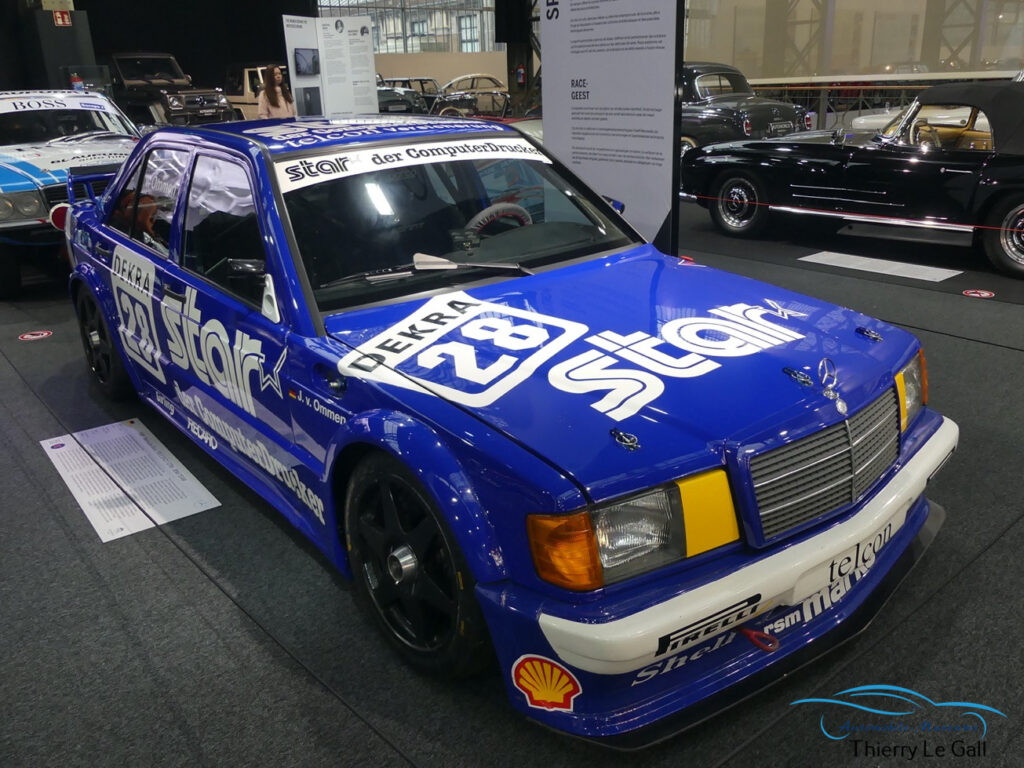
Another sporting icon is the 300 SEL 6.9L prepared by AMG, nicknamed “Rote Sau” (Red Sow). Not very elegant, but symbolic of this extraordinary car that came to challenge Porsche, BMW, and Ford Capri sports cars on the racetrack. By finishing second in the 1971 24 Hours of Spa, it instantly established AMG’s reputation. Due to a lack of tires suitable for its weight and power, its sporting career was short-lived, and it was subsequently used by Matra to test jet aircraft landing gear, which it did not survive. The model on display is an exact replica of the race car. Another important milestone in Mercedes history, the 190 E Evo was derived for the DTM from the Mercedes 190 E 2.3-16, a souped-up version of the compact and rather placid sedan. It marked Mercedes’ strong comeback in competition with the DTM (German Touring car races) before tackling more ambitious challenges.


In a very different sector, the 600 was a large, very luxurious limousine, produced from 1964 to 1981, at the top of the range. Mercedes intended the 600 for heads of state and royalty, particularly in this 6.24m “stretched” Pullman version. The 1961 220 S (Type W111) represents an important generation of Mercedes cars called “Heckflosse” (fin tails in German) because of the specific shape of their rear wings. Far from the extravagance of American car fins, this body style was typical of Mercedes in the 1960s and 1970s.


Directly derived from the sedan, the 220 SE coupe adopted a square rear end and abandoned the small fins. Designed by Paul Bracq, the style heralded the SL convertible known as the “Pagoda” (see further on in the S/SL section). More surprising in this constellation of luxurious or powerful cars, or even both, is the O 319 bus model, which represents the brand’s important commercial vehicle division, with a model that shares many technical features with its car production. With its sunroof and upper side windows (known as “mountain windows”), it is a luxury model! In the central aisle, we note the presence of the Mercedes CLA, a 100% electric sedan which, by happy coincidence, has just won the title of Car of the Year.


Innovation as a guideline
A luxury and prestigious brand, Mercedes-Benz is also known for its many innovations in all technical fields, including engines, safety, and comfort features. In 1936, the 170 H was the first compact car designed to broaden the automotive customer base. With its streamlined body and rear engine, the 170 H featured equipment inspired by more luxurious models. In a way, it was the forerunner of premium compact cars.


In the same year, Mercedes introduced the 260 D, the first mass-produced passenger car with a diesel engine. 170 “landaulet” models were built, used exclusively as taxis (even then!), as they had a low fuel consumption of 9 L/100 km.


The Mercedes 300 (W186), often called the “Adenauer” after the German chancellor who used several of them from 1949 to 1963, offered rare options such as a telephone. It competed directly with Bentley and Rolls-Royce in terms of both equipment and price, but with better performance thanks to its 6-cylinder engine, also used in the 300 SL! The 170 (W136) was the brand’s volume model in the late 1940s, and the 170 S version was the first Mercedes to take the suffix S (Sonder for special or superior). It was based on a modernized pre-war model and was available as a sedan, coupe, and convertible.


Introduced in the early 1990s and produced from 1996 onwards, the SLK (sportlich, leicht, kurz, meaning sporty, light and short) brought the coupe-convertible configuration with a retractable hardtop back into fashion. The opening mechanism was complex and spectacular, designed to preserve a reasonable amount of trunk space. Many manufacturers followed this style with designs of varying degrees of success, but the Mercedes SLK lasted longer, with nearly 25 years of production and four generations (under the name SLC for the last generation). The SLK was powered with 4-cylinder (gasoline and diesel), V6, and even V8 engines for the AMG versions, with power ranging from 180 to 360 horsepower.


In 1998, the A160 was a complete break from the rest of the Mercedes range: compact, with a minivan-style design, unique architecture, and smaller engines, it took customers by surprise. But ultimately, the “A” range proved to be a commercial success and a model for winning over customers, and it subsequently gave rise to the A-Class, which returned to a more conventional design.
At the other end of the spectrum, several large AMG sedans and station wagons symbolize the race for power, even excess, that German manufacturers have been engaged in since the 1990s. The Mercedes AMG S65 “Final Edition,” with its enormous 630-horsepower twin-turbo V12 and copper-colored accents on the bodywork, is a prime example.


Sport and Racing
Since its inception, Mercedes-Benz has earned a solid reputation and a prestigious track record in motor racing. It is therefore logical to see a space dedicated to motorsport in the historical exhibition, exploring the many areas in which the manufacturer has distinguished itself. Mercedes developed the W25 in 1934 for the new Grand Prix formula. According to legend, the W 25 exceeded the weight limit of 750 kg by one kilogram. The mechanics reportedly scraped off the white paint, the German racing color, revealing the bare bodywork. Thus, was born the legend of the Silver Arrows, which has been widely revived, including in the modern era of F1.


Nearby, one of its heirs, another Silver Arrow, 2014 F1 World Champion with Lewis Hamilton, allows us to measure how far we have come in 80 years and the courage of the Grand Prix drivers of the 1930s! Mercedes left motor racing in 1955 following the dramatic accident at the 24 Hours of Le Mans that year. Pierre Levegh’s 300 SL had veered off the track and crashed into the stands, killing more than 80 people. Mercedes did not return to the racetrack until 30 years later.


In endurance racing, Mercedes powered the Sauber C9 from 1985 onwards. In 1989, the Sauber-Mercedes cars sported a new silver livery, continuing the glorious tradition of the Silver Arrows, and won the 1989 24 Hours of Le Mans. In endurance racing, but also in the GT3 championships, Mercedes entered AMG GTs derived from the (small) production car. The AMG GT3 on display is a 2023 car entered by the Belgian team Boutsen VDS.


The DTM (German Touring Car Championship) is an extremely popular series in Germany, and several teams entered 190 E 2.3s in the mid-1980s before Mercedes officially entered the series. The Mercedes-Benz 190 E EVO 1 DTM – RSM shown here was entered in 1989 by the team founded by Helmut Marko, a former F1 driver and endurance racer (winner of the 1971 24 Hours of Le Mans on a Porsche 917), also well known for his involvement with the Red Bull F1 team.
Mercedes’ presence in rallying and rally raids is less visible, and the spectacular 1984 Mercedes-Benz SLC 500 Dakar serves as a link between these two worlds. In 1980, Mercedes entered rallying with the 450 SLC, a coupe version derived from the SL. With this robust but heavy car, Mercedes won a few African rallies but stood no chance against the Group B cars with their turbo engines and four-wheel drive. A German team then bought two cars to modify them and race in the 1984 Paris Dakar. The car was modified for this purpose but was not successful. More suited to this type of terrain, the ML 430 SUV was adapted in 2000 for the World Cross-Country Rally Championship. Facing specially prepared vehicles, the ML 430 defended itself honorably, winning its category in 2001 and 2001.


Supercars & Concept cars
In this space dedicated to concept cars and supercars, visitors can discover rare and even unique models, as one might expect. The C111 (shown here in its 1970 version 2) remained a concept car, despite a seemingly respectable number of customers willing to buy it. With its spectacular styling, gullwing doors, and 350-horsepower 4-piston rotary engine, it would undoubtedly have been a worthy successor to the 300 SL. The C 111 remained a laboratory car, with a total of 16 examples built, which were used for various experiments, including diesel engine tests.


The Mercedes McLaren SLR was developed jointly by Mercedes and McLaren in the 2000s, when both companies were enjoying considerable success in F1. With a carbon fiber body, an AMG V8 supercharged engine producing over 600 horsepower, and a top speed of over 200 mph, the SLR undoubtedly has the attributes of a supercar, with around 2,000 units built in seven years. The 722 Edition is a special series (150 units) that is slightly more powerful (650 horsepower), its name referring to the race number of the 300 SL that Stirling Moss drove to victory in the 1955 Mille Miglia.


Next to it, the Mercedes-Benz SLR McLaren “Stirling Moss” is an SLR “speedster,” meaning it has no roof or windshield, just a small wind deflector. Only 75 examples of this tribute car to the British driver were built in 2009, at a price of over €1 million, and you had to already own an SLR to be eligible to buy one! The version on display was driven (and signed) by Sir Stirling Moss himself!


The 1998 CLK GTR looks like it has just come off the racetrack, which makes sense since it is the road-legal version of the FIA GT 1 car, of which only 20 were built specifically to enable racing homologation. Another model close to racing is the CLK DTM AMG, built in a small series (100 units) to celebrate Mercedes’ DTM title win in 2003.


The SLS also claims to be the heir to the 300 SL Gullwing, with the same “Gullwing” doors. The variant on display is the SLS Black Series, inspired by the SLS AMG GT3 race car. Its 6.3-liter AMG V8, hand-assembled according to the “one man, one engine” principle, delivers 60 hp more than the “standard” version of the SLS.


The 1928 Mercedes-Benz 630 S Transformable Sport is not quite a concept car, as such a thing did not exist at the time, but rather a body created by D’Ieteren, a famous Belgian coachbuilder, on a Mercedes 630 S chassis, of which only three were made.


S-Class and SL
The Mercedes S and SL generally represent the top of the Mercedes range, with S for sedans and limousines, and SL for coupes and convertibles. Several generations of S sedans and SL convertibles or roadsters can be found on two parallel lines. “S” stands for Sonder, meaning special, indicating a high level of comfort and quality, while SL stands for “sportlich, Leicht” or Light Sport. While the name was justified for the 300 SL “Gullwing” coupe, this is less the case for the current versions, which are more luxury convertibles than sports cars.


Nevertheless, this range includes some of the most desirable Mercedes models, such as the 190SL roadsters, developed to offer a more affordable model, and the 300 SL, which succeeded the 300 SL coupe. The 230 SL “Pagoda” (type W113), later available as the 250 SL and 280 SL with larger engines, takes its nickname from the slightly concave shape of its hardtop. Designed by Paul Bracq, it is a very elegant convertible that is still highly regarded today.


The next generation, the R107, was longer, wider, and heavier, but still elegant. More luxurious than sporty, it was produced for nearly 20 years, from 1971 to 1989, with slight stylistic changes but many technical improvements, and was the first generation of SLs to feature V8 engines with the SL 500. This SL also enjoyed a successful career in movies and TV series, symbolizing success and glamour. The SL Type R129 continued in the same vein from 1989 to 2001, this time going as far as a V12 engine in the SL 600, with the range topped by an official AMG version.


The last generation featured in this retrospective, the SL Type R230, arrived in 2001 (until 2011) and adopted the coupe-convertible solution pioneered by the SLK. It was a great success with nearly 170,000 cars produced, including just over 3,000 with the V12 engine increased to 6.5 liters.


At the same time, we can follow the evolution of the “S” sedans (later renamed the S-Class after the adoption of these labels). After the aforementioned 170 S, whose bodywork retained a “pre-war” style with separate wings at the front and rear, Mercedes adopted the “Ponton” style for the W 180, which was fitted with 1.8-liter and then 2.2-liter 6-cylinder engines, such as the 220 S on display.


The 300 SE (W112), derived from the W111 “Heckflosse” models, was fitted with the 3-liter 6-cylinder engine from the 300 “Adenauer,” a luxurious finish, and numerous chrome accents to differentiate it from the classic models (and in particular the already numerous taxis). The W108, which succeeded it in 1965 (there is not necessarily any logic in the succession of type numbers), did away with the small rear wing spoilers. One version was equipped with a 6.3-liter V8 engine and was named the 300 SEL 6.3 (L for long, as the wheelbase was longer than that of the S and SE), rather than the 630 SEL, as logic would have dictated. Another 3.5-liter V8 version appeared under the name 280 SEL 3.5 (on display), in order to better position itself against the competition from V8 sedans and limousines.


Starting with the W116, the S became the “S-Class” and was equipped with 6-cylinder and V8 engines (such as the 350 SE shown), and even, for the first time in a luxury model, a turbo diesel engine (300 SD). A huge commercial success, the W126 was produced from 1979 to 1991 and sold over 800,000 units, with a wide choice of gasoline and diesel engines and power ratings, with the top-of-the-range 560 SEL on display, equipped with a 5.6-liter V8 and 300 horsepower.
The last model presented in this section, the S 500 AMG 6.0L, a W140-type S-Class, brought a host of innovations: ESP, xenon headlights, side airbags, etc. The car on display belonged to King Albert II. Delivered as an S 500, it was soon equipped with an AMG V12 6.0 engine, hence its name.


G-Class
To conclude this non-exhaustive review of the exhibition, let’s not forget two representatives of the Mercedes G-Class. Originally developed as a military vehicle, this utility off-roader, a competitor to the Land Rover Defender, has become, over the years and generations, a luxury SUV. The 1990 230 GE Cabrio already reflects this evolution towards luxury, especially in this convertible version. And to finish with total excess, the Mercedes-Maybach G650 Landaulet (2017) is equipped with a 6-liter twin-turbo V12 engine producing 630 horsepower, measures 5 meters long and 2 meters high, and weighs nearly 3 tons. All 99 units planned were sold at the 2017 Geneva Motor Show where it was unveiled!


Decoration
As always with Autoworld exhibitions, the cars are presented in a spacious layout, allowing visitors to get a good look at them. Large photos separate the themed areas, recalling the history and key events of the brand with the star logo, while in the competition zone, a large screen shows films about Mercedes’ presence in motor racing.


Spread across the various exhibition spaces, several display cases present an exceptional selection of Mercedes-Benz miniatures, generously loaned by Eric Janssen, one of Belgium’s leading collectors. In addition to its usual items, the museum shop naturally offers a selection of “star-studded” souvenirs, and visitors can admire a 300 SL Roadster in the museum’s “Bagnole” (car in popular French) restaurant.


The photos on this page belong to Automobile-Museums, no right of reproduction without express permission.