
Helice Galerie, 3 rue des Vosges, 54122 Flin, France
Until November 28, 2026
The exhibition dedicated to Citroën’s racing history, held at Helice Galerie, has been extended for a few months until November 2026. I’ve already had the opportunity to present this exhibition, organized in collaboration between Helice Galerie and L’Aventure Citroën, which traces Citroën’s greatest moments and victories in motorsports. The display is primarily chronological, though it does include a few themed sections. Rallies and rally raids naturally take up the bulk of the exhibition, starting with the prototypes developed by Citroën’s racing department based on the DS and SM. The DS won numerous competitions in the 1960s, at a time when rally cars were very close to production models, and reliability took precedence over pure performance.


Beyond the 1970s, Citroën focused on African rallies, where the DS models benefited from their hydropneumatic suspension. But evolving competition led to the development of more high-performance and powerful prototypes, such as these “coupe” DS models, which were lighter and more agile, featuring a larger engine or even the SM’s V6. The SM was also entered in races in versions that were virtually stock, apart from a few reinforcements and protection for the mechanical components, notably winning the 1971 Rally of Morocco, one of the toughest in its history. More spectacularly, the shortened 1972 SM coupé raced in Portugal and Ivory Coast (Bandama Rally). The 1977 CX, which finished second in the 1977 Tour of Senegal, returned to the concept of a production car with simple reinforcements.


In the early 1980s, Citroën turned its attention to Group B, first with the small Visa, which was converted to four-wheel drive, and then with the BX 4 TC, featuring a turbocharged engine producing nearly 400 horsepower and still four-wheel drive. However, the resources available were insufficient to compete with the stars of the discipline, and Group B came to an end before the car was fully developed. Its best result was a 6th-place finish at the 1986 Rally Sweden, driven by Jean Claude Andruet. Another spectacular BX was Jean-Luc Pailler’s Turbo 4×4 Rallycross, with which he won the French championship in the discipline in 1992 and 1993, as well as the European Championship in 1993. Its 2-liter 4-cylinder engine produced 550 horsepower!


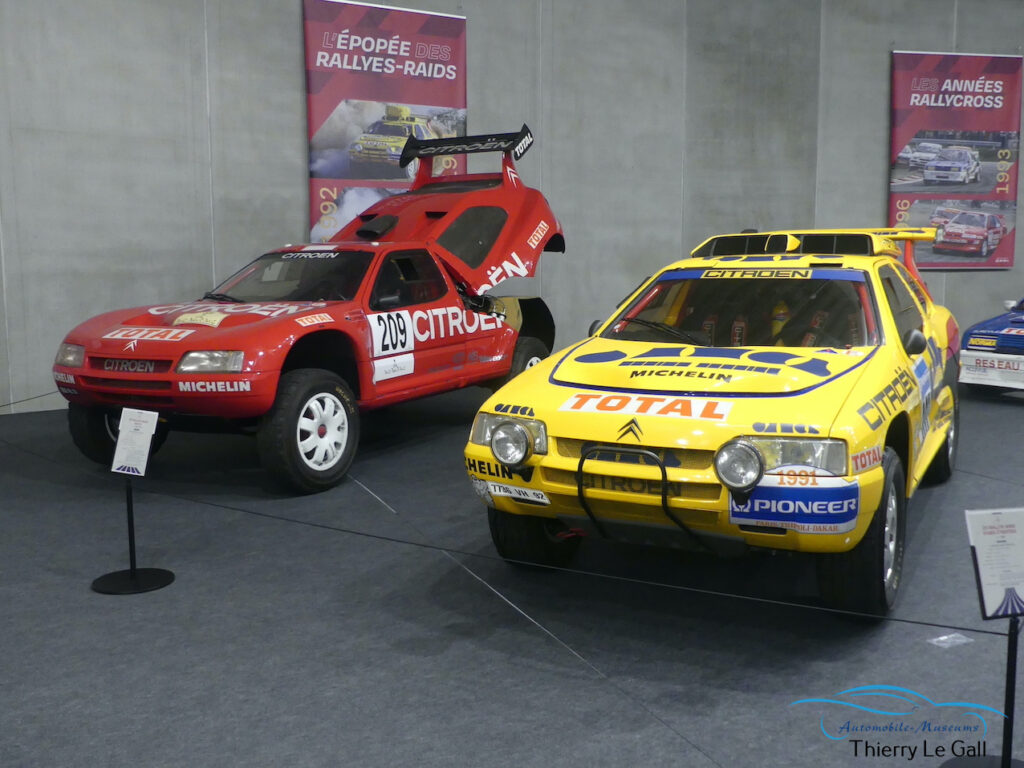
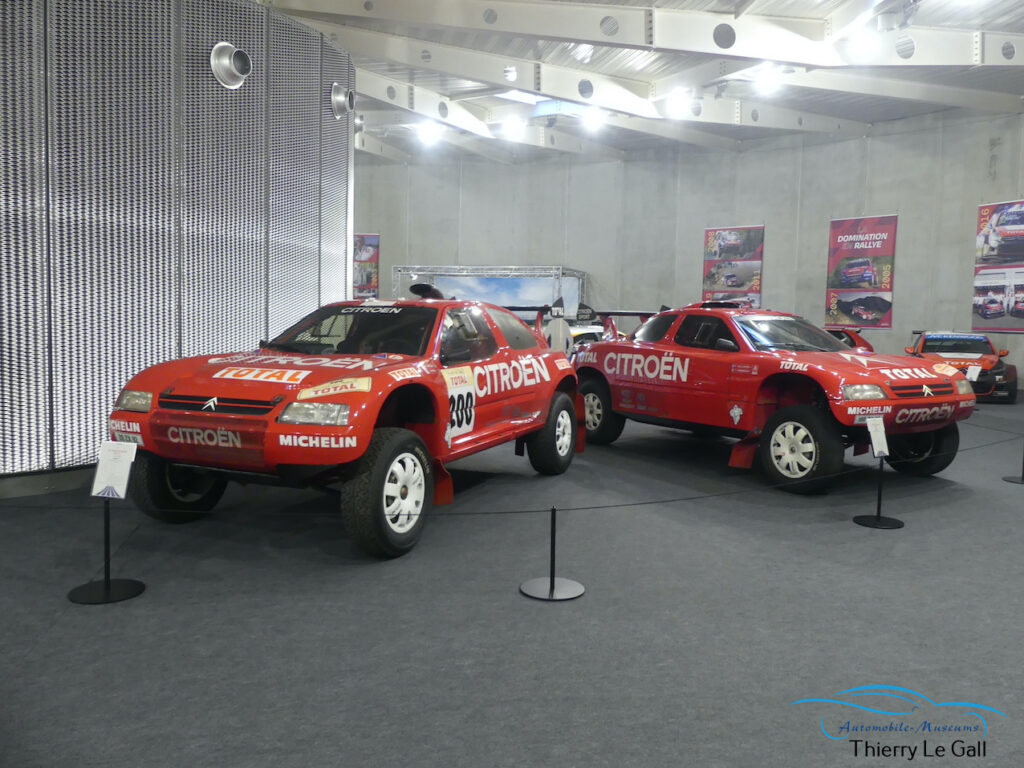
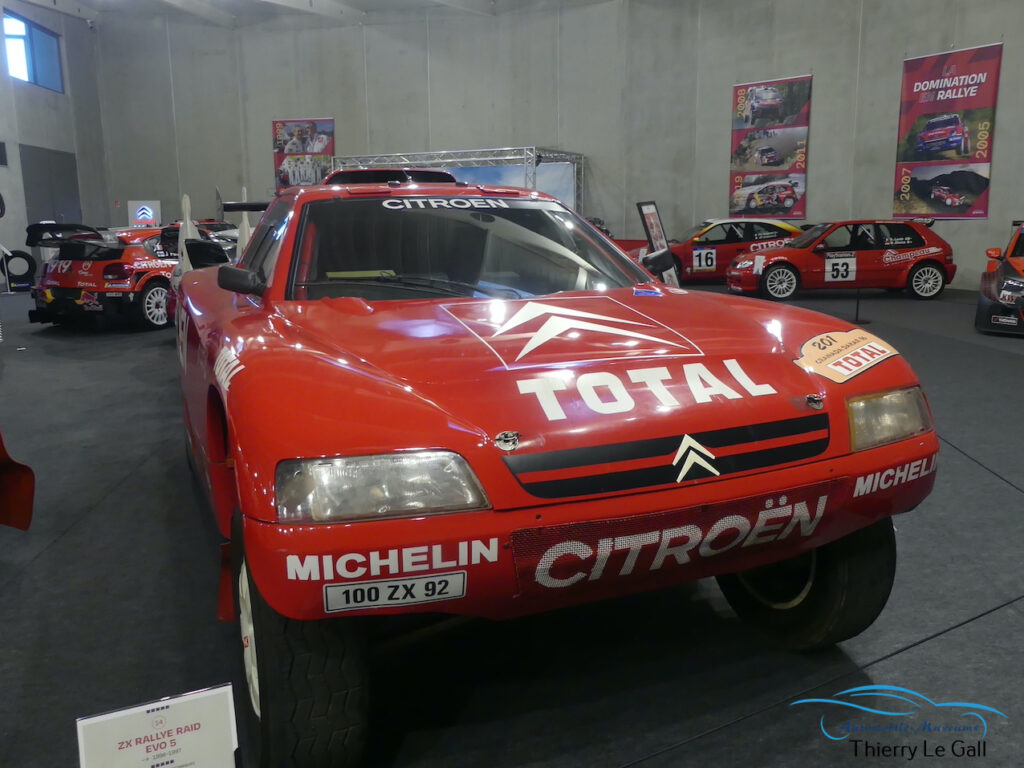
In the early 1990s, the impressive ZX Rallye Raid was the ultimate weapon on the Dakar trails. With six models on display, from the 1991 “narrow” version to the 1996 EVO 5, visitors can trace the evolution of the ZX. Three of the cars on display are Dakar winners (1991, 1994, and 1995), and another won the Paris-Moscow-Beijing rally held in 1992.




In 1998, Citroën officially returned to rallying, first with the two-wheel-drive Xsara “Kit-Car,” then starting in 2001 with the four-wheel-drive Xsara WRC, which enabled Sébastien Loeb to win his first world title. This glorious era for the chevron-badged brand, marked by 102 victories, 8 manufacturers’ titles, and 9 drivers’ titles (all won by Loeb), is epitomized by the saga of the Saxo, Xsara, C4, DS3, and C3.


Let’s not forget the C-Elysée, a sedan derived from the ZX and manufactured in China, which enabled Citroën to win three Drivers’ titles (with José-Maria Lopez) and a Manufacturers’ title in the World Touring Car Championship (WTCC). The display of cars is complemented by several engines and numerous posters highlighting key dates and major figures from this long history in motorsports.


Find more information in the first article.
Practical Information
Opening
| Monday to Friday | 9 a.m. to 5 p.m. |
| Special opening one Sunday per month with guided tours | 10 a.m. to 5 p.m. |
Rates
€8 / Free for members of L’Aventure Peugeot Citroen DS
Copyright Photos Automobile-Museums, no right of reproduction without express permission.