
January 28 to February 1, 2026, Paris, France
Here is part 1 of the article on Retromobile 2026, devoted to the main exhibitions and manufacturers. Part 2 is mainly dedicated to exceptional car dealers, auction houses, museums and clubs
Trends & feelings
Retromobile 2026 was the 50th edition of the show dedicated to classic cars and automotive enthusiasts. It was a huge popular success with record attendance, more than 180,000 visitors, representing a spectacular 24% increase in visitor numbers! The passion for cars and motorcycles is alive and well! The success was such that the organizers have already announced that they are considering solutions to improve access conditions in 2027. The show had moved within the Parc des Expositions, and instead of being spread over several halls, this year it was grouped together on the three floors of Hall 7 (except for a small section dedicated to cars priced at less than €30,000). I personally found this new layout more practical because each floor had its own defined areas, making it easier to move between topics of interest.
As in previous years, themed exhibitions, manufacturers, dealers, accessory suppliers, publishers, artists, museums, clubs, and associations offered visitors an exceptional showcase, covering the history of the automobile and all facets of automotive passion. In addition, a new show was associated with Retromobile, with the arrival of Ultimate Supercar Garage, which showcased supercars and hypercars, another aspect of mechanical passion. A specific article is dedicated to the report on this show.
Before going into detail and showing pictures of this edition, here are a few impressions and trends, which are inevitably subjective. A trend that was confirmed again this year is that more and more car manufacturers are coming, drawing on their heritage to celebrate an anniversary or the launch of a new generation of models, sometimes both at the same time. Citroen made an official comeback after last year’s DS anniversary exhibition, and Opel exhibited for the first time. However, there is still a significant gap between the modern models on display, often 100% electric, and the gems brought out of storage.
The growth of historic racing, whether on the track or on the road, also explains the increasing number of race cars offered for sale: Formula 1, sports prototypes, or rally cars, sometimes with a real pedigree or similar to models that have raced, making them eligible for historic events. Some replicas, “continuations,” or upgraded models may also be eligible based on their history, which significantly increases their value. This is also a great opportunity for enthusiasts to explore the history of motor racing from the early 20th century to the 2000s in just a few hours.
Another trend is the growing presence, particularly among major dealers and auction houses, of supercars, hypercars, and other hyper sports cars (words are running out to classify ever more powerful and extreme cars). Despite the launch of a parallel show dedicated to supercars, the vast majority of dealers remained at Retromobile (I will come back to this later). Many of these cars are not necessarily very “retro,” but Retromobile is a unique opportunity for enthusiasts to get up close to them. Most dealers play along by presenting well-designed stands, showcasing the cars and allowing visitors to approach them.
The crowds sometimes make it necessary to filter entries to avoid congestion, requiring patience on the part of visitors. And I would like to take this opportunity to take a swipe at those who only allow entry by “invitation” on the pretext of security! The section of the show dedicated to collectible cars sold for less than €30,000 can be an opportunity to get started in the classic car world on a limited budget, as international dealers’ prices are inevitably (much) higher.
We are now eagerly awaiting the Rétromobile 2027 program, which will take place from February 3 to 7, 2026. In the meantime, Rétromobile USA will be putting on another show from November 19 to 22, 2026, in New York. Given the passion for cars in the US and the size of the market, there is no doubt that the Rétromobile teams will put on a superb event!
Thematic Exhibitions
BMW Art Cars Exhibition
The flagship exhibition at Retromobile 2026, featured on the official poster, was dedicated to BMW Art Cars, particularly those that raced in the 24 Hours of Le Mans. In 1974, Herve Poulain, a famous auctioneer and amateur driver, had the slightly crazy idea of having a race car painted by an artist and entering it in the 24 Hours of Le Mans. He managed to convince Jochen Neerpasch, director of BMW Motorsport, to provide him with a BMW 3.0 CSL to be painted by Alexander Calder, one of the major artists of modern art. In February 1975, the green light was given, and the Art Cars adventure began.


The first BMW 3.0 CSL “Calder” was entered in the 1975 24 Hours of Le Mans, with professional drivers Jean Guichet and Sam Posey at the wheel, and rookie Herve Poulain himself, who thus realized his dream. BMW subsequently assessed the impact of the initiative and decided to continue along this path. To date, around 20 Art Cars have been presented, each one a unique work painted by a renowned international artist. All the Art Cars are kept by BMW, which exhibits a few of them in turn at its museum in Munich. In 2025, to mark the 50th anniversary of its Art Cars, BMW organized the “BMW Art Car World Tour,” lending or exhibiting a number of cars for events and museum exhibitions around the world.


For Retromobile, BMW presented the seven cars that participated in the 24 Hours of Le Mans between 1975 and 2024, beautifully displayed and arranged in a semicircle. In addition to the BMW 3.0 CSL “Calder” placed in the center on a rotating podium, visitors could rediscover the 750-horsepower 3.0 CSL biturbo coupe “Frank Stella” (1976), the BMW 320 by Roy Lichtenstein (1977) and the M1 “Andy Warhol” (1978).


The series ended for various reasons, but in 1999 BMW returned to Le Mans with the LMR V12, this time decorated by American artist Jenny Holzer. Although the LMR V12 was entered in the 1999 24 Hours, an accident during the first practice sessions prompted BMW to withdraw its cars before qualifying. In 2010, sculptor Jeff Koons designed a paint job for the M3 featuring brightly colored stripes that converged toward the nose of the car, giving the impression of speed.


Finally, in 2024, BMW officially returned to Le Mans with its M Hybrid V8 Hypercar painted by Julie Mehretu. It should be noted that while the Art Cars have not always been successful on the track, they have all marked milestones in the relationship between automobiles, racing, and art.
Bugatti exhibition, Railcars & Mechanical Curiosities
It was certainly one of the biggest attractions of this year’s show! In partnership with two institutions in Mulhouse, the Cite du Train and the National Automobile Museum, and with the support of Eiffage Rail, Retromobile exhibited a Bugatti railcar, a little-known yet monumental achievement by Ettore Bugatti. Following the commercial failure of the Bugatti Royale, which was too expensive and, above all, appeared during a period of crisis, Bugatti found himself with a stock of engines and in serious difficulty. He then had the idea of developing a high-speed train using the powerful engines of the Royale.


Depending on the version, these railcars were equipped with two or four engines, developing up to 800 horsepower for the four-engine models. Relatively light for its size (23 meters long, less than 40 tons), the Bugatti railcar could travel at a cruising speed of 140 km/h, which was remarkable in the 1930s. These railcars, of which 88 were produced (most between 1933 and 1938), saved Bugatti. The last Bugatti railcar ran on the French Riviera lines until 1958.


The model on display is the only survivor of this production, a 23-meter “Presidential” model, fully restored (except for the engine) and usually on display at the Cite du Train in Mulhouse. It was perfectly showcased, installed on a section of track, and a platform (a little low) allowed visitors to see the interior layout.


In addition to this railcar, the exhibition brought together some of Bugatti’s more unusual and little-known creations. The 1931 Type 56 “En Cas” is a small electric car used by Ettore Bugatti to get around the Molsheim estate. Of the ten or so built, only four remain. However, Bugatti is better known for its racing cars, a few rare examples of which were on display. The Type 32, nicknamed the Tank because of its distinctive shape, was developed for the 1923 French Grand Prix. Its career was short-lived, with the Type 35 replacing it the following year. Its lightweight and compact riveted aluminum bodywork illustrates early aerodynamic research. The 1928 Type 47 Torpedo is a unique model equipped with a 16-cylinder U-shaped engine, the result of coupling two 8-cylinder inline engines. Presented to the public for the first time at this show, the Type 47 successfully competed in a few races in Switzerland, but was not followed up.


Another unique model, the 1939 Type 59.50B II Sport two-seater, competed in a few races in 1939, notably winning the Luxembourg Grand Prix. Its 8-cylinder supercharged engine delivered around 500 horsepower, which explains the presence of twin rear wheels, no doubt a solution to transfer the power. Of course, the war put an end to all racing programs. In 1956, the Type 251 was the first rear-engined Formula 1 single-seater. Another original feature was its transverse 8-cylinder inline engine. Although original and highly innovative, the 251 only competed in one Grand Prix, as Bugatti lacked the resources to develop it and continue competing.


The touring cars on display represented Bugatti’s latest designs. The Type 64 was Jean Bugatti’s last design, which was to be presented at the Paris Motor Show in October 1939 and give the brand a new lease of life. Following Jean’s death in August 1939 and the outbreak of World War II, the Type 64 remained a one-off model. After the war, Bugatti attempted a comeback with the Type 73, which had been developed in secret during the war. The last creation of Ettore Bugatti, who died before its presentation, the Type 73 was presented as a prototype without an engine at the 1947 Paris Motor Show. Five chassis were built, only one with bodywork, and it was not until 1959 that the Type 57 was completed and put into running configuration.


The last attempt by Roland Bugatti, Ettore’s second son, was the Type 101, presented at the 1952 Geneva and Paris Motor Shows. The Type 101 was based on a 1940 Type 57 chassis and engine, but there were insufficient funds to relaunch the brand. Only six units were built, including the two on display at Retromobile, a red convertible and a blue coupe, both by the Colmar-based coachbuilder Gangloff, who worked regularly with Bugatti.


The golden age of rallying
Every year, Retromobile proposes a competition theme, and in 2026 the show celebrated rallies, particularly those from the period between 1960 and 1990, often considered the golden age of the discipline. During this period, the world of rallying became more professional, with manufacturers becoming more directly involved, giving rise to the World Rally Championship (WRC) in 1973. In turn, different manufacturers made their mark, bringing new practices and new technologies: specific cars with the Lancia Stratos, turbo and all-wheel drive by Audi in the early 1980s, the excesses of Group B between 1982 and 1986…


Designed in collaboration with the Gino Macaluso Foundation, this retrospective brought together an exceptional selection of legendary cars. Italian rally driver Gino Macaluso began collecting rally cars when he retired from his sporting career. The Mini Cooper and Ford Cortina Lotus were very similar to mass-produced cars, but won numerous rallies in the 1960s and 1970s, before more specialized cars took over. This was the case, for example, with the Alpine A110, the famous “berlinette,” which was light and agile and performed wonderfully on all terrains. Alpine won the first World Rally Championship when the discipline moved from a European championship to a world championship in 1973.


Due to Gino’ nationality and the large presence of Italian manufacturers in rallying, the latter, and Lancia in particular, are well represented: Fulvia (1970), Stratos (1976), Delta Integrale (a 1990 Group A and a spectacular 1992 “Safari Evolution”), 037 Group B (1984)…


While it is not surprising to find a Fiat 131 Abarth (1978), the Fiat X1/9 Abarth Prototipo, which mainly competed in Italian asphalt rallies, is less well known.


The early 1980s marked the era of the super-powerful Group B cars, with the Audi Quattro (1981) revolutionizing the discipline, before Peugeot introduced its legendary Peugeot 205 Turbo 16 (1986), which dominated rallies until Group B was discontinued. In asphalt rallies, however, Renault managed to compete with these four-wheel drive cars with its spectacular R5 Turbo (1981).


After several years of domination by the Lancia Delta in its various incarnations, Toyota became heavily involved and the Celica GT-4 ST165 (1990) achieved Japan’s first successes in the World Rally Championship. The most recent car on display is a Fiat, the Punto Rally Super 1600, which is in a sense the second division of rallying, allowing young drivers in particular to gain experience before moving up to the top category.


Steve McQueen Exhibition: A Passion for Speed
Steve McQueen’s passion for cars, motorcycles, and motorsports is well known, so it was only natural that Retromobile would pay him tribute through the lens of his passion. As a race car driver, one of his best results was a second-place finish at the 1970 12 Hours of Sebring. One of his great regrets was surely not being able to compete in the 24 Hours of Le Mans. He also raced motorcycles, mainly in trials and in the Baja California races. It is therefore fitting that the Steve McQueen exhibition is located in the motorcycle section of the Retromobile show.


This major retrospective dedicated to the “King of Cool” featured several iconic cars and motorcycles that had marked the actor’s life. On the car side, there were notably the two cars from the chase scene in the Bullitt movie, undoubtedly one of the most famous in cinema history: the Ford Mustang Fastback V8 GT 390 and the Dodge Charger driven by the gangsters. These were not the actual cars from the film, but replicas of the models used in the chase.


Next to them was a gray Ferrari 250 GT Lusso, identical to the one his wife offered him for his birthday! Finally, the F100 pickup truck belonging to his friend and stunt coordinator Bud Ekins was well suited for transporting their motorcycles to races in the desert.


Most of the motorcycles on display were Triumphs, a brand that Steve McQueen particularly liked. In addition to the Triumph Trophy TR6 identical to the one he rode in the movie “The Great Escape,” the exhibition featured a 1966 Triumph Rickman Metisse MK3, several T120s prepared by Bud Ekins for riding in the desert and on tracks, and a Husqvarna 400 Cross that he rode in his last motorcycle races, as well as the Honda CR 250 “Elsinore” that he did not ride but used to advertise for Honda in the US. The exhibition is, of course, decorated with movie posters and large archival photos.


Manufacturers
In 2026, the number of car manufacturers exhibiting is growing, and their stands are now almost on a par with those at traditional motor shows. Here, I will review the main stands, in alphabetical order, without aiming to be exhaustive. Furthermore, with a few exceptions, I will not always mention the modern models on display.
Alfa Romeo
No global anniversary or special theme at Alfa Romeo, but three historic cars, including one extremely rare model. The 1966 Spider “Duetto” 1600 came to Paris to celebrate its 60th anniversary. Its original design, characterized by its rounded “cuttlefish bone” rear end, was created by Pininfarina. The 1955 Alfa Romeo 750 Competizione was supposed to race in the Sport 1500 category, but it remained a prototype and only two were ever built. However, it participates in historic races such as the “Mille Miglia” and the Goodwood Festival of Speed.


The 33/2 “Periscopica” from 1967 was the car that launched the 33 line at Alfa Romeo, marked by numerous endurance victories and two World Championship titles in 1973 and 1975. The “2” refers to the 2-liter V8 engine, and the 33 later evolved into the 33/3 with the V8 increased to 3 liters. Its nickname “Periscopica” comes from the air intake above the cockpit.


Alpine
Alpine is switching to all-electric, a bold move, especially for the replacement of the A110 Berlinette. So, the brand brought part of its history back to life with a few classic “combustion engine” models, including two ‘original’ A110s and a “modern” A110. The “Normandy green” A110 1600 SX was the last to be produced in 1977 at the Dieppe factory, while the A110 1800 Group 4 finished second in the 1975 Tour de Corse, just a few seconds behind the formidable Lancia Stratos, which was developed specifically for competition.


The modern version is an A110 R Ultime, developing up to 345 horsepower, more than double that of the 1975 racing version!


Citroen
Citroen recently unveiled a highly innovative concept car called ELO, a small, fun and clever minivan. This inspired the idea for its official return to Retromobile to showcase several innovative concept cars from the past, particularly those that focused on space and interior layout.


The oldest is not strictly speaking a concept car, as it is one of the prototypes of the 2CV dating from 1939. It was hidden during the war to prevent it from falling into enemy hands. With a single headlight, a single windshield wiper, no door handles, a canvas top, and the famous basket of eggs on the back seat that it had to be able to transport across a field without turning them into an omelet, it was an authentic prototype.


The C10 (1956) had a “teardrop” silhouette on a very compact and lightweight architecture using techniques that had come from aeronautics at the time. In the 1980s, technology was highlighted through two concepts. The pyramid-shaped Karin (1980) placed the driver in the center of the cabin, removed the rearview mirrors and replaced them with cameras, and replaced the windshield wipers with an air blower system.


The Activa 1 in 1988 had a very aerodynamic wedge-shaped silhouette and featured a sophisticated system combining electronics and hydraulics. The on-board telephone and head-up display were well ahead of their time. The other concepts on display focused on interior space and comfort, with Xanae (1994) and C-Cactus (2007) featuring a hybrid diesel-electric powertrain.


In a nod to the Retromobile anniversary, the La Traction Universelle club exhibited on the Citroen stand a splendid red Traction 15-6 convertible, one of only three known to exist in the world. The 15-6 with its 6-cylinder in-line engine was the top of the Citroën range, especially the convertible which appeared in 1939. This car was already on display at the club’s stand during the first edition of Rétromobile!


DS Automobiles
DS Automobiles is a young brand that cannot draw on its history, but it can rely on Citroen’s prestigious models. At Retromobile, the brand exhibited several vehicles used by the French Presidency, which is hard to beat in terms of prestige and history! In 1968, the Elysee Palace received a raised and lengthened DS, designed by Citroen and fitted out by Chapron. At 6.53 m long and 2.13 m wide, the Presidential DS is more imposing than elegant (subjective opinion), but it meets the specifications which stipulated that the car had to be longer than that of the President of the United States! Leather, wood, a spacious, comfortable rear compartment with air conditioning and a rounded partition window – the whole thing is opulent! On the other hand, the space for the driver is more modest.


This DS was ultimately used relatively little, as the Presidential SM arrived in the Presidential fleet in 1972. It was a long, four-door convertible (5.60 m), but still elegant (again, personal opinion). The front and engine are identical to the standard Citroen model, but the wheelbase is longer and the rear has been modified, in particular to accommodate the rear seats and the convertible top. With thick carpeting, leather upholstery, and a bar for standing during parades, the SM Presidentielle was inaugurated by President Pompidou for the visit of Queen Elizabeth of England, and was later used by Presidents Giscard d’Estaing, Chirac, and Mitterrand.


More classic in style, the 1965 DS 21 Pallas was used by General de Gaulle from 1965 onwards, mainly for his journeys between Paris and his residence in Colombey-les-Deux-Eglises. It was slightly modified, with flag holders in the front bumper and side sun visors in the rear seats, for example. Purchased at auction by its current owner, it underwent a complete restoration to restore it to its former glory, while retaining as many original features as possible. I will no doubt return to the story of its restoration in the near future. The link with the present was made with DS No. 8 Presidentielle, delivered to the Presidency of the French Republic in April 2025. It is the world’s first 100% electric official car.


Honda
Honda has just announced a new generation of its Prelude coupe. While this coupe was produced continuously from 1977 to 2001 across five generations, it took 25 years after the end of the fifth generation for the G6 to arrive. The 2026 Prelude is an elegant coupe, a species that has become rare in the ranges of mainstream manufacturers, with a hybrid powertrain. Logically, Honda offered visitors the chance to see two examples from previous generations.


The original Prelude, produced from 1977 to 1982, was derived from the Civic. With a 1.5-liter engine producing 80 horsepower, it was not exactly a sports car. It was the first mass-produced car to feature an electric sunroof. In its third generation (1987-1992), the Prelude was more powerful, with a 2-liter engine producing 180 horsepower. It stood out with its retractable headlights and was the first production car to be equipped with four-wheel steering.


Mazda
This year, Mazda is celebrating the 35th anniversary of its victory at the 1991 24 Hours of Le Mans with the 787B rotary engine (Wankel patent). Mazda was the first and for a long time the only Japanese manufacturer to win the 24 Hours of Le Mans and remains the only one to have done so with a rotary engine. The model on display, usually exhibited at the 24 Hours of Le Mans Museum, is an exact replica of the winning 787B.


The theme was therefore the rotary engine, for which the brand remains the sole champion in global production, and Mazda exhibited three older models using the same engine technology. These included the attractive Cosmo Sport 110S coupe, the first Mazda with a 110-horsepower Wankel engine. The car is quite rare, as fewer than 1,200 were produced in four years, from 1967 to 1972.


The R130 Luce is another little-known coupe, which was positioned as a refined luxury car, the top of the Mazda range at the time. Introduced in 1969, the R130 Luce was only sold in Japan and the US, and fewer than 1,000 were built.


The best-known Mazda with a rotary engine is the RX-7, which was available in several generations (before becoming the RX-8). The first-generation RX-7 (1979) on display was intended to be a sports coupe, competing with the Datsun 240 Z, Porsche 924, and Nissan Skyline.


Mercedes
Let’s congratulate Mercedes’ decision to play along fully for this 2026 Retromobile show, with no electric sedans or hybrid SUVs, just star-studded gems, mainly highlights from the SL saga. Mercedes chose as its theme the “1000 Miglia,” the famous Italian road race, which is now being revived in historical form. The star of this selection was a 1955 300 SLR racing car (type W196 S) in the “Streamliner” spyder version. This car, designed for road and endurance racing, is in fact a Formula 1 car with bodywork. While the closed “Uhlenhaut” variant, of which only two were built, is the most expensive car in automotive history (€135 million in 2022), a 300 SLR like the one on display sold for €46 million in 2025, the same price as a Ferrari 250 GTO in a recent sale.


Several classic models from the brand with the star were on display, all purchased by Mercedes-Benz Heritage, serviced, restored, and offered for sale with a “Mille Miglia pack,” ready to participate in the Italian classic. Enthusiasts had the choice between a “classic” gullwing 1955 300 SL, a 1956 190 SL roadster, and a 1955 220 “Ponton.” While the 300 SL’s successes in this race are well known, it is less well known that several Mercedes 220s also took part.


The last 300 SL on display was a 1960 coupe, “in its original condition” awaiting restoration, illustrating Mercedes-Benz Heritage’s ability to carry out complete restorations.


Morgan
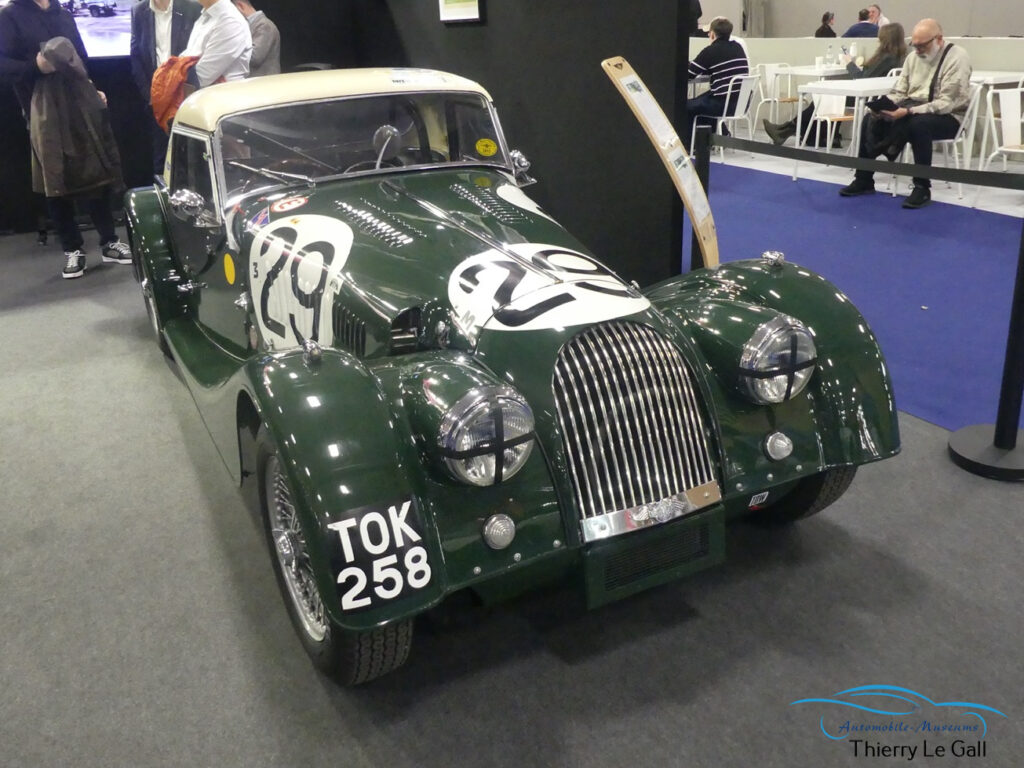
Morgan is a regular exhibitor at Reétromobile, and it is true that its flagship model, the PlusFour, has retained lines similar to the original 1950s version. This year, Morgan showcased a special Plus 4 Supersports, as it was the Morgan that won its class at the 1962 24 Hours of Le Mans, the only Morgan to have achieved this feat. Directly derived from the Plus 4 road car, the car is obviously optimized for racing, focusing on lightness and reliability rather than power.
Opel
Opel exhibited at Retromobile for the first time, with three sporty cars. The 1978 Kadett C coupe had only 55 horsepower, but the car was very light and agile. Its additional high-beam headlights and fog lights, black rearview mirrors, and alloy wheels are testament to its sporty ambitions. It still delights enthusiasts in hill climb racing. The Monza GSE, a large coupe produced between 1978 and 1986, inaugurated Opel’s GSE sports label, which can still be found today on the sportiest models. With its 3-liter inline six-cylinder engine developing 180 hp, this rear-wheel drive car boasts a very respectable top speed of 215 km/h.


The Manta 400 is not the most famous of the Group B cars, but the 1982 factory model on display is one of only three survivors out of the 17 that were built. Nicknamed the “Lucky Car,” this Manta never had a serious accident and won the French Rally Championship with Guy Fréquelin and several international successes with Henri Toïvonen and Ari Vatanen at the wheel.


Peugeot
At Peugeot, 2026 will see the return of the GTI label with the launch of the e-208 GTI, an electric version. To win over enthusiasts, Peugeot recalled the glory days of its GTI label with a complete collection of 205 GTIs: the first 1.6L 105 horsepower model from 1984 and the 115-horsepower evolution from 1986. The latest version featured a 1.9-liter 130 horsepower engine that worked wonders in this lightweight car. It is not certain that the same sensations will be found in its distant electric descendant.


This “130 hp” model was exhibited in two versions: a “classic” red model with a sunroof and a rare (only 3,000 units produced) 1990 205 GTI 1.9 ‘Griffe’ in a special “Fluorit” green color. The 115 horsepower 205 GTI was also available in a convertible version, called the CTi, which was also on display in this retrospective.


For those who couldn’t afford a rare and expensive 205 Turbo 16, Peugeot offered a “Dimma” body kit that gave a GTI the look of a T16. Buyers could also fit an engine kit. Finally, a “real” 205 T16, one of a small series of 200 units built for Group B homologation, completed the GTI exhibition.


It’s worth noting that the large Peugeot stand was adorned with beautiful red carpet, just like the one in the 205 GTIs!


Porsche
Porsche celebrated the 75th anniversary of its Motorsport division at Retromobile, logically placing the emphasis on competition in three very different styles. The 919 Hybrid is the latest Porsche to have won the 24 Hours of Le Mans, with three consecutive victories in 2015, 2016, and 2017. Despite strong performances, Porsche did not repeat the feat with its 963 Hypercar and canceled its participation in 2026, focusing on other disciplines, notably endurance racing in the US.


It was on American circuits that the 924 GTR made its mark in the early 1980s. The heavily modified model on display was loaned by its owner. The much more imposing Cayenne S SUV on display was specially developed for the 2007 Transsyberia Rally.


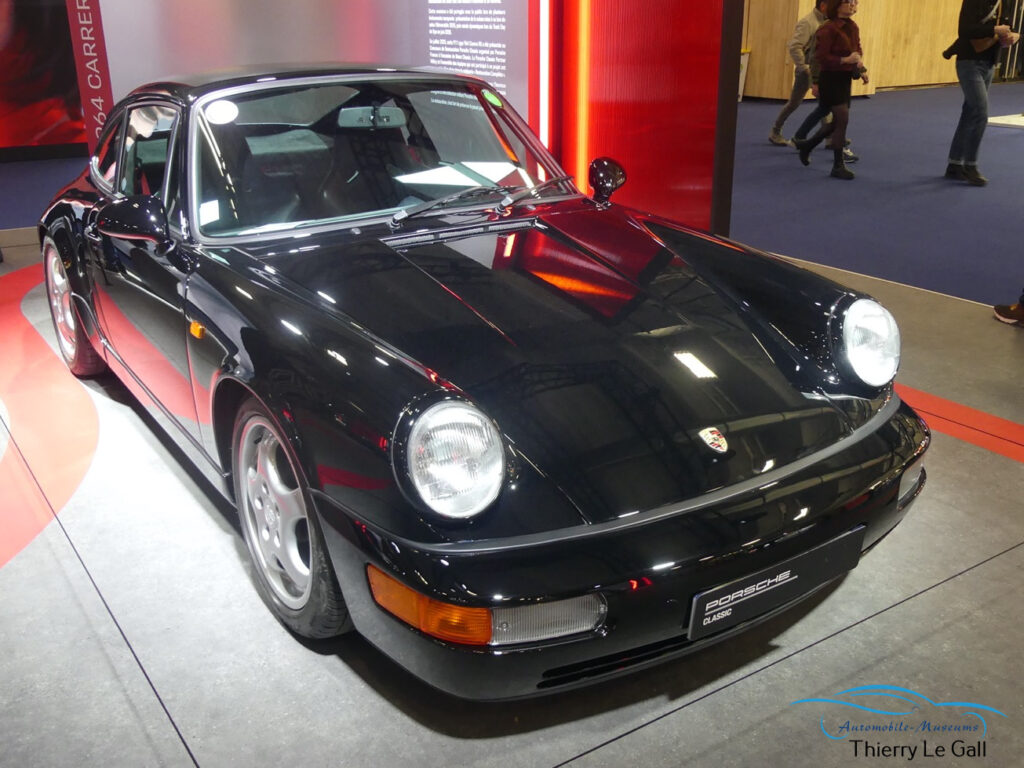
A distinctive feature of Porsche is the very high proportion of its classic models that are still on the road, whether they are 356s or older 911s. Some Porsche centers offer dedicated services, as illustrated by the 1992 911 Carrera RS Type 964. In early 2025, the car was undergoing restoration and was exhibited on the Porsche Retromobile stand. Since then, restoration has been completed and it won the Porsche Classic Restoration Competition organized by Porsche France at the 2025 Le Mans Classic.
A beautiful green 911 Turbo S convertible represented the current range.


Renault
Renault exhibited at Retromobile under the brand name “The Originals Renault,” a division dedicated to promoting its heritage. The star of the brand is the all-new Clio, hence the “Cliorama” exhibition, which presented previous generations of its successful car, most of them in red to match the launch color of the new Clio. The exhibition featured classic versions of the Clio, but above all a number of special editions and rarer versions.


The Clio has had some luxurious versions, such as the Baccara, with its leather interior and burr walnut dashboard, and the 2019 Initiale Paris. Better known to enthusiasts, there have been many sports versions in the Clio’s career. The Clio Williams (1993) is recognizable by its blue color and gold rims. It was a reference to the Renault and Williams partnership in F1 and was a commercial success. The car on display belonged to Franck Williams.


In 2000, the RS (Renault Sport) 2.0 16V was handed over to the racing department to be improved in terms of chassis and mechanics. Much more radical, the Clio V6 partly followed the formula of the R5 Turbo 2: two seats, mid-rear engine, very wide rear, but this time with a 230 hp V6 engine. The Clio R27 F1 Team (2007) is a limited edition that directly references the titles won by Renault in F1 with the R27.


The Clio has also been a racing car, both on the road and on the track, and the Cliorama exhibition presented a small selection of these models. The Clio “Group A,” based on the Clio I, was introduced in 1991 and was successfully used in rallying by Jean Ragnotti and Philippe Bugalski. In 1994, the Clio Maxi Kit Car complied with the new FIA regulations for 2-liter, 2-wheel drive cars. Still based on the Clio I, the Kit Car developed 260 horsepower and won numerous races and championships in its category.


The Clio evolved in line with changes to FIA regulations, and the Clio Super 1600, which appeared in 2002, set the standard in its category, winning the European Super 1600 Championship in 2004 and 2005, as well as numerous European national titles.


While the Clio has made a name for itself on the roads, it has also been available in circuit versions. The Clio III Cup, developed from the Clio III RS, was produced in more than 900 units to race on circuits around the world.


As part of its heritage program, Renault certifies garages that have the specific skills to maintain and restore old Renaults, a program illustrated by a garage “corner” displaying a splendid Dauphine. It should be noted that Renault has begun work on its future museum, which is scheduled to open in 2027.
Skoda
Skoda boasts a 125-year history in motorsports and therefore presented a number of sports and racing models. The oldest car on display was a 1937 Popular Sport Coupé, a lighter version featuring an aluminum roof, developed for rally racing in the 1930s. The Skoda 100 OHC is a small open-top sports car, of which only two were built, which raced from 1958 to 1963, mainly in what was then Eastern Europe.


Another leap forward of almost 20 years brings us to the Skoda 130 RS, of which 300 were built between 1975 and 1980. Based on the S110 R, lightened with an aluminum hood, doors, and roof, widened fenders, and a fiberglass-reinforced plastic tailgate, and with a more powerful engine thanks to two carburetors, the 130 RS competed in numerous rallies, notably at Monte Carlo. In a way, it paved the way for the Skoda Fabia WRC of the 2000s, one of which was cut in half to reveal its inner workings.


Meanwhile, the Skoda Favorit 136 had been developed to compete in national and international rallies in the early 1990s, as well as endurance races in the 136H version. The 2017 Fabia R5 Combi is a show car derived from the Fabia R5s that have been competing in rallies since 2015.


Volkswagen
In 2026, Volkswagen is celebrating the 50th anniversary of the Golf GTI and presented the previous generations. Although the Golf GTI has always been part of the range, it has evolved considerably, with its power output almost tripling between the 110 horsepower of the first GTI in 1976 and the 326 hp announced for the 50th anniversary special edition! In 1976, Volkswagen introduced the Golf GTI, a sporty derivative of its compact car that had arrived on the market two years earlier.


It was an instant success, and not only did Volkswagen produce many more than expected, but the Golf GTI also gave rise to a new category of cars: small, affordable, and fun sports sedans, which appeared from almost all mainstream manufacturers, under the GTI label, such as the 205 for Peugeot, or other in-house names, but always in the same spirit. The Golf is now in its eighth generation, and each generation has had its own GTI.


Eight Golfs, arranged in a circle from the Golf I with its rectangular grille incorporating additional headlights and the large GTI logo to the Golf 8 “50th Anniversary Edition”. The Golf 2 was on display in its more powerful 16S version, while the Golf 6 was presented in a convertible version. Like Peugeot, Volkswagen also exhibited a future electric GTI based on the ID.Polo.


Ducati
Amidst all these car manufacturers, and away from the motorcycle section, Ducati had a large stand to celebrate its centenary, even though the first motorcycles (actually motorized bicycles) did not appear until 1946. Previously, Ducati manufactured capacitors and radio components, then calculators, cameras, and radios…


In a few days, part 2 of this report will follow…
Photos on this page belong to Automobile Museums, no reproduction rights without the Owner’s express permission.