
Louwman Museum, The Hague, Netherlands
Until January 3rd, 2027
The Louwman Museum will celebrate the brand with the bull emblem during the winter of 2026 through 13 truly exceptional cars. Frustrated by constant clutch and transmission problems with his Ferrari, and, above all, by Enzo Ferrari’s contempt and condescension, Ferruccio Lamborghini, an established tractor manufacturer, decided to build his own sports car. Relying on Gian Paolo Dallara for the chassis design, Giotto Bizzarrini to develop the V12 engine, Franco Scaglione for the styling, and Carrozzeria Touring for the bodywork, Lamborghini laid the foundations for his brand, based in Sant’Agata Bolognese, not far from Maranello, in just two years.
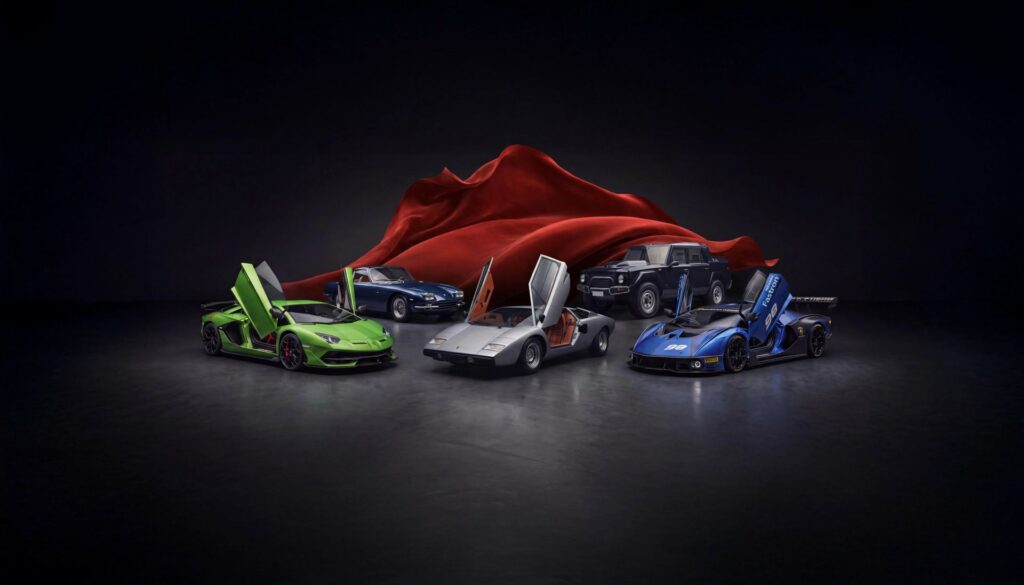
Unveiled in 1963, the 350GT was produced in a run of 120 units in 1964–1965, before giving way to the 400GT, which V12 engine had been increased to 4 liters. At the 1966 Geneva Motor Show, Lamborghini surprised the sports car world with the Miura, the first true Lamborghini sports car. Its sensational design, flowing bodywork, large, fully-tilting hood, and mid-mounted V12 engine were revolutionary. Launched as a “shadow” project by Lamborghini’s engineers under the name P400, it was a road car with racing DNA. Ferruccio Lamborghini was thrilled with the project when it was presented to him and immediately gave the green light to what would become the first modern supercar and elevate Lamborghini to the elite ranks of sports car brands. The Miura also ushered in a tradition of naming the brand’s models after fighting bulls.


With the Espada, Lamborghini once again made a splash with a new 4-seat GT that combines elegance and sportiness, still powered by the brand’s signature V12 engine. Its low-slung profile, low roofline, bright interior, and imposing overall length give the Espada (the bullfighter’s sword) a unique character and an instantly recognizable silhouette. Offered in three successive series distinguished by minor modifications, the Espada sold more than 1,200 units over its 10-year production run. New visual sensation with the Countach (a word from Piedmontese slang equivalent to “Wow!”, the reaction, according to legend, of a local person during the prototype’s first unveiling). While the Miura was fluid, the Countach, designed by Marcello Gandini, was angular and more radical, defining the Lamborghini style that still prevails today: stocky, wide, with sharp angles and straight lines. The Countach also introduced upward-opening doors, a feature that would become the hallmark of all subsequent V12-powered Lamborghini sports cars. Launched in 1974, the last model rolled off the production line in 1990 after more than 2,000 units had been produced.


Only 52 examples of the 1976 Silhouette were produced, making it rarer than many of Lamborghini’s limited-edition special models. This two-seater sports car was developed from the four-seater Urraco. This V8-powered model was replaced by the Jalpa, which had an almost identical body design. The LM002 (Lamborghini Militaria 002) is a unique vehicle in the brand’s history. It was not designed as an off-road sports car but was intended for military use. This four-seat off-road behemoth (2.7 metric tons weight), built around a tubular chassis and powered by the Countach’s 5.2-liter V12 engine producing 450 hp, was never used for military purposes; all units (approximately 300) were sold to private individuals. Capable of reaching 160 km/h in the desert and over 200 km/h on the highway, the LM002 had a 290-liter fuel tank!


With the Diablo, Lamborghini returned to using names inspired by bullfighting. “Diablo” was, in fact, the name of a fighting bull that belonged to the Duke of Veragua in 1869. The 1993 SE30 (30th Anniversary Special Edition—150 units) marked the brand’s 30th anniversary. The Jota on display is an even rarer version, produced in a run of just 15 units, in compliance with Annex J (Jota in Spanish) of the FIA regulations. The SE30 features a revised front end, redesigned side air intakes, a restyled rear wing, an additional 30 hp, and a weight reduction of 125 kg achieved by removing numerous comfort features (stereo, air conditioning, etc.). A Diablo 6.0 is also on display in this selection. While it retains the name and appears to have essentially undergone a major facelift (new front end and a thoroughly redesigned rear), the changes under the hood are substantial. The chassis is actually that of the future Murcielago, and the V12 engine, increased from 5.7 to 6.0 liters, delivers 550 hp. The “SE” version on display, limited to 42 units, is the latest special edition featuring several mechanical enhancements.
The Murciélago (a fighting bull from 1879) was the first entirely new Lamborghini developed after the company was acquired by Audi. Although the design was slightly less “aggressive,” it retained its wing-style doors and its V12 engine, which was still based on Bizzarrini’s original design but now produced 580 hp.
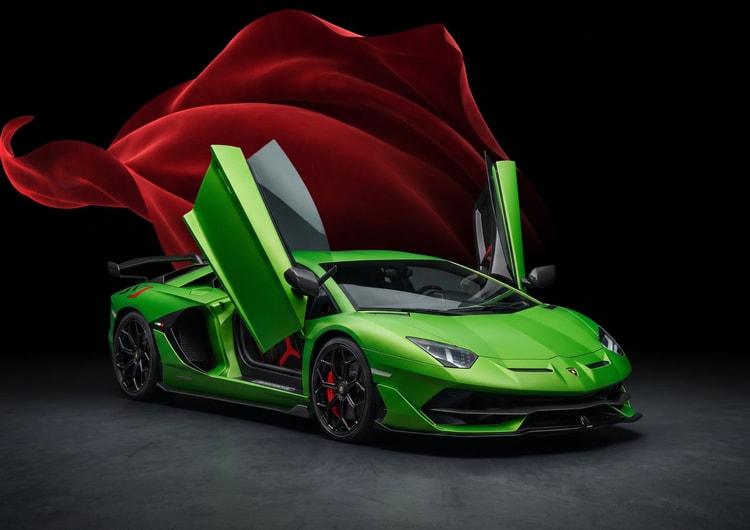
In keeping with bullfighting tradition, the Aventador is named after the fighting bull that won the “Trofeo de la Peña La Madroñera” in 1993. In every other respect, the Aventador represents a revolution for Lamborghini. It was the first model since the brand’s inception to be equipped with an all-new V12 engine (6.5 liters, 700 hp), a full carbon fiber monocoque, and active aerodynamics. Demonstrating the enthusiasm for the brand under its new owner and the transition to a new industrial era, the Aventador has surpassed the combined production of all its predecessors!
The Essenza SCV12 was not road legal nor compliant with any official racing category. Lamborghini developed this model exclusively for use on private tracks or during unofficial track days. The Essenza SCV12 (Essenza—no compromise—Squadra Corse V12) was designed to deliver the ultimate driving experience on a closed circuit. Lamborghini invited Essenza buyers to join other owners for track days at “prestigious” circuits, with support from a team of factory technicians tasked with assisting owners with tires, transportation, and other technical matters. With the Revuelto (a Spanish fighting bull that competed in the arenas of Barcelona around 1880), Lamborghini launched its first hybrid sports car, producing over 1,000 hp thanks to a new 6.5-liter naturally aspirated V12 engine paired with three electric motors. The Revuelto draws inspiration from iconic models such as the Countach, the Diablo, and the Aventador, as well as from the world of motorcycles. The engine, for example, is fully exposed; the exhaust pipes are positioned high up in the center of the vehicle’s rear; and the Revuelto offers an unobstructed view of its rear tires.


Temerario, which means “daredevil” in Italian, takes its name from a bull from Madrid (1875), and this Lamborghini, unveiled in 2024, certainly packs a punch with its 4.0-liter V8 producing 800 hp that revs up to 10,000 tr/min, assisted by three electric motors, bringing the system’s total power to 920 hp. With this V8, Lamborghini bids farewell to the V10 used in the Gallardo and Huracán. The Temerario draws on the hexagonal design language introduced by Marcello Gandini in 1967 on the Marzal concept car, later incorporated into the Countach’s design, and which remains a defining feature of Lamborghini’s style, as evidenced by the daytime running lights, taillights, air intakes, and exhaust tips.


Archive photos from Automobile-Museums; models and colors may differ from those on display. No reproduction rights without express permission.
The photos on this page belong to the Louwman Museum, no right of reproduction without the express permission of the museum.