
January 29 to February 1, 2026, Paris, France
Introduction
Ultimate Supercar Garage (USG) is a new show held in parallel with Rétromobile Paris, dedicated, as its name suggests, to the world of supercars and hypercars. Given the ultra-exclusive target market for these cars, it was a risky venture, but it proved to be a great success. More than 63,000 visitors walked the aisles of the show to admire rare and even unique cars. Several of the most prestigious manufacturers made the trip, offering a selection of models never before gathered in one place. We can only hope that this success will be repeated and that the few absentees (such as Konigsegg and McLaren) will come to exhibit at the next edition, already planned for February 3-7, 2027.
The dedicated hall featured several established manufacturers, a few ambitious newcomers, a number of dealers, Restomod specialists, and a handful of exhibitors from the world of luxury and exceptional automobiles. It should be noted that while several “manufacturers” have presented electric supercars in recent years with enormous power ratings in the thousands of horsepower, USG featured almost exclusively cars with combustion engines. Perhaps this is a sign that at a certain level of price and exclusivity, automotive passion and electrons do not mix well!
Many models also featured a return to manual transmissions, which are supposed to put the “driver” back at the center of the driving experience. Let’s now take a look at the lineup, by exhibitor category, without being exhaustive, focusing on automobiles.
Manufacturers
Let’s congratulate the organizers for their success in bringing together manufacturers whose models are rarely shown to the public, except in exclusive showrooms. In addition, a large stage on which the cars could be displayed allowed for live presentations with exclusives and French or even world premieres. Here, I will review the main stands, without aiming to be exhaustive, and in alphabetical order.
Alfa Romeo
Alfa Romeo exhibited two very different cars, both limited editions. The first was a 33 Stradale, a limited edition of 33 models inspired by the 1960s 33 Stradale, itself a limited edition road version of the Tipo 33 racing car. Designed by Franco Scaglione, it is considered one of the most beautiful Alfa road cars. So there are worse things to be inspired by. The new 33 Stradale is largely based on the Maserati MC 20, from its carbon monocoque to its 630 hp 3-liter twin-turbo V6 engine. As befits this level of exclusivity, each owner was able to customize their car extensively. It should be noted that Alfa Romeo initially planned a 100% electric version, which was abandoned due to a lack of enthusiasm from buyers.
While the 33 Stradale clearly falls into the “supercar” category, the second model on the Alfa Romeo stand may come as a surprise at this show, as it is a Giulia. But beware, this is a special edition, even an exclusive one, the Giulia Quadrifoglio Luna Rossa, limited to only ten units (all of which have been sold). It takes its “Luna Rossa” label from the Italian sailing team Luna Rossa, which helped define it. Its 2.9-liter twin-turbo V6 engine develops 520 hp and propels it to 300 km/h. Carbon fiber is omnipresent, the aerodynamics are meticulous, notably with a surprising two-part rear spoiler, and an original iridescent two-tone paint job completes its exclusive look.


Aston Martin
There is a wide range on display at the Aston Martin stand, with four models ranging from the Valkyrie LM to the DBX SUV. The Valkyrie LM is an ultra-limited series of just 10 cars, reserved for track use, and is almost identical to the Valkyrie Hypercar that competes in the WEC and IMSA championships (endurance, 24 Hours of Le Mans). The differences between the LM and the hypercar are minor and relate to elements such as ballast and the regulation system imposed by the FIA for racing.


It features a naturally aspirated 6.5-liter V12 engine developing nearly 700 horsepower for a car weighing around 1,000 kg and the complex aerodynamics of a real race car. Lucky customers benefit from a comprehensive training program on and off the track (simulator), which is essential for taming such a monster! The car on display, in a two-tone white and blue paint job, was the first to be delivered, generously loaned by its owner. Next to it is the Valhalla, Aston Martin’s (small) series supercar, with 999 units planned, a plug-in hybrid that combines a 4.0-liter twin-turbo V8 and three electric motors to deliver over 1,000 horsepower! It is inspired by the Valkyrie and benefits from Aston Martin’s F1 experience but is intended to be less radical than the Valkyrie LM.


Next to these extreme cars, the Vanquish seems almost tame! Yet with its traditional wide Aston grille and sculpted rear end, it still commands respect. Its 5.2-liter twin-turbo V12 engine delivers 835 hp and a top speed of 214 mph. Three cars, three styles, three engine technologies for three very different but complementary uses!


Bentley
At Bentley, British luxury and refinement are cultivated, as demonstrated by the selection of materials, leather, wood, and aluminum presented at the stand, with a craftsman working on a steering wheel, the human touch still very much present in the finishes. In addition to a Bentayga SUV, visitors could admire a Continental GT, the latest generation of Bentley’s Grand Touring expression. The 4-liter twin-turbo V8, combined with an electric motor, delivers nearly 700 horsepower for absolute comfort on the road.


Derived from the Continental, the Supersports is much sportier, without being radical. Limited to 500 units, the Supersports is powered by Bentley’s twin-turbo V8 engine delivering 666 horsepower, features numerous carbon fiber parts, and has been redesigned for improved aerodynamics. Bentley also exhibited a Batur convertible, a very limited series (18 coupes, 16 convertibles) built by Mulliner, again based on the Continental, but with an even higher level of refinement and customization.


Bugatti
Among all these prestigious brands, Bugatti was undoubtedly the star of the show, with the world premiere of its new jewel, the Bugatti Veyron FKP Hommage! This model is part of the Bugatti “Solitaire” program, which creates unique models developed specifically for a single customer. It’s not just about customization, even at the highest level, but about creating a truly one-of-a-kind car. Let’s break down the name: Hommage because the car is a double reference, first to the Veyron, which was the first model of the new Bugatti era unveiled in 2005, and second to Ferdinand Karl Piëch (hence FKP), who initiated this new era by buying the rights to Bugatti while he was the head of Volkswagen.


Ferdinand Piëch, grandson of Ferdinand Porsche, is well known for his involvement in the development of the Porsche flat-6, Porsche’s competition program around the 908 and especially the 917, which led Porsche to victory at the 24 Hours of Le Mans, and the technical revival at Audi with the Audi Quattro program and rally victories. With the acquisition of Bugatti in 1998, Ferdinand Piëch wanted to create a supercar that would surpass everything else on the market in terms of performance and prestige. The first expression of this was the Veyron 16.4 with its 8-liter W16 engine, with 4 turbos delivering 1001 horsepower and reaching a top speed of 400 km/h! The Bugatti Veyron FKP Hommage retains the main aesthetic features of the Veyron 16.4, but has been subtly modernized, for example at the front with much slimmer headlights (specially developed) made possible by technical advances over the last 20 years.


When viewed side by side, the original Veyron 16.4 and the FKP Hommage reveal their similarities and differences. The FKP Hommage still features the legendary W16 engine, but as it is based on the Chiron Super Sport architecture, this time the engine delivers 1,600 horsepower. While remaining faithful to the Veyron’s style, the chassis and aerodynamics have been redesigned to match the performance level. A center console carved from a block of aluminum, exclusive fabrics developed specifically for this model, and a unique harmony of colors and materials are some of the distinctive features of this unique car. The name of the end customer is not known, nor is the price, which is said to be well over €10 million! However, the model presented is a show car, and Bugatti will continue to develop and refine it for delivery in early 2027. Suffice to say that opportunities to see the Veyron FKP Hommage will be extremely rare!


Alongside these two cars, Bugatti also exhibited the W16 engine, a true mechanical masterpiece. On the other side of the aisle, Bugatti stayed with the Veyron theme, with four models representing some of the stages in the Veyron’s evolution during its ten years of production, starting with the Veyron 16.4 (red and black), the Veyron Grand Sport (pearl white), the roadster version of the 16.4 produced in 58 units, the more powerful (1,200 horsepower) and faster (official top speed of 256 mph, measured at 267 mph) Veyron Super Sport (blue), of which only 48 were produced, and finally the Veyron Grand Sport Vitesse (red and white), a combination of the Grand Sport roadster and the performance of the Super Sport (92 units).


Donkervoort
Dutch manufacturer Donkervoort presented its latest creation, the P24RS. After distributing Lotus Seven and Caterham cars in the Netherlands, Joop Donkervoort began building his own cars in 1978, initially with Ford engines and then with the renowned Audi 5-cylinder engine from 1998 onwards. With the P24RS, Donkervoort has taken a new step forward. The car remains very light, with a combination of aluminum tubing and carbon fiber for the chassis, shell, and bodywork. The engine is a 3.5-liter twin-turbo V6 from the Ford GT, but redesigned by Donkervoort, notably with turbos and in-house software, whose power can vary from 400 to 600 horsepower, depending on the mapping chosen by the driver.


As the car weighs 840 kg when fully fueled, performance, especially acceleration, promises to be stratospheric. While the P24 RS has adjustable controlled suspension, no driving aids are offered as standard: no ABS, no ESP, no power steering, and a 5-speed manual transmission. The interior is well finished, with Recaro bucket seats and Sabelt harnesses, but minimalist. Don’t look for a 14-inch multimedia screen, there isn’t one! Unquestionably, this P24 RS is intended for the most athletic drivers, and production will be limited to 150 numbered units. One last original feature: Donkervoort has reinvented pop-up headlights, with a small arm for the LED high beams that pops up on each side of the car’s nose.


Ferrari – Charles Pozzi
Ferrari was represented at the show by Charles Pozzi, who brought four models representing the Cavallino’s different ranges. The 296 GTB (the red one) is the latest generation of Ferrari “berlinetta” with a mid-engine, featuring a V6 Turbo combined with an electric motor for the first time. This mid-engine range had been equipped with a V8 since the 308 in the early 1970s (the Dino 246 V6 was not “officially” a Ferrari at the time). Its electric motor with a rechargeable battery allows it to travel a few kilometers with “zero emissions,” but also provides significant additional power to the combustion engine, with a total power output of 830 horsepower.


Traditionally, this range includes a sportier version, and that is the role of the 296 “Speciale” (the green one). The car is slightly lighter, with power increased to 880 horsepower, and more complex aerodynamics. It is particularly recognizable at the rear with its large diffuser, two-part spoiler resting on the wings, and enlarged exhaust.


The SF 90 XX Stradale (the blue one) is also part of the “Speciale range,” a step up in terms of power (and price). Until now, Ferrari XX models were reserved for the track and not street-legal. The SF 90 XX Stradale is an XX due to its more radical character, its extra power (30 horsepower), and its aerodynamics, including a large fixed spoiler (which we haven’t seen on a road-going Ferrari since the F50 in 1995), but approved for road use as a “Stradale.”


Finally, the Monza SP2 (the black one) belongs to the “Icona” range, a limited edition series whose design is inspired by legendary models. With a naturally aspirated 810 hp V12 engine in a mid-front position, it embodies typical Ferrari DNA. With two seats, monocoque carbon fiber seats, no windshield but two small wind deflectors, and a double hump behind the occupants, its lines are directly inspired by the racing “barchettas” of the 1950s.


Lamborghini
No Urus SUVs here—Lamborghini has decided to focus on the theme of the show: supercars. The Temerario (green) has ditched the Huracan’s naturally aspirated V10 in favor of a twin-turbo V8, combined with three electric motors, for a total maximum power output of 920 hp, a jump of nearly 300 hp. The overall design echoes Lamborghini’s typical modernized style with, as expected, active aerodynamics.


A step above, the Revuelto (gray) unveiled in 2023 is Lamborghini’s first hybrid (excluding concept cars). It retains the naturally aspirated V12, but it has been thoroughly redesigned and now delivers 825 hp. With the addition of three electric motors, the total power output exceeds 1,000 horsepower. The rear is particularly spectacular, with a huge carbon diffuser, two hexagonal exhaust pipes, and the combustion engine exposed without a protective glass cover.


The Fenomeno (yellow) is one of the limited series that occasionally tops the Lamborghini range, offering more power and exclusivity. The Fenomeno, which celebrates 20 years of the “Centro Stile Lamborghini,” is powered by the Lamborghini V12, combined with three electric motors to deliver a total power output of 1,080 hp. Only 29 examples of this true manifesto of aerodynamic excellence will be produced. Carbon fiber is omnipresent, both in the bodywork and the interior, with 3D-printed parts. The lucky few customers will naturally be able to customize their car with an almost unlimited range of colors and materials.


Lotus
Lotus’ strategy can sometimes be difficult to follow, between lightweight sports cars, electrification, and the quest for volume. For this Ultimate Supercar Garage show, the British firm exhibited its 100% electric Evija supercar in its “Emerson Fittipaldi” edition, limited to eight units (out of a total production run of 130). Unveiled in 2022 to commemorate the Brazilian driver’s 1972 World Championship title in a Lotus-JPS 72, the Evija Emerson Fittipaldi features the black and gold livery of the Lotus JPS.


The Lotus-JPS 72 is certainly one of the best-known and most beautiful Lotus F1 cars, with a simple, sleek wedge shape and a black and gold livery that enhances its beauty. The Evija is (very) powerful, with Lotus announcing more than 2,000 horsepower (!!!), but at 1,700 kg (even if this weight is still reasonable for an electric car), it strays a little from Colin Chapman’s “Light is Right” concept! Given the limited appetite among customers for electric sports cars, it remains to be seen whether the brand will succeed in selling all 130 Evijas, especially at around €2 million each before tax.
Maserati
Maserati exhibited its GT2 Stradale, a street-legal supercar but closely derived from its racing model. Its aerodynamic appendages, diffuser, giant rear wing, spoiler, carbon fiber hood, and front wing flaps show that it has just escaped from the racetrack. It is powered by the in-house “Nettuno” V6 engine, which delivers 640 horsepower for a top speed of 325 km/h.


More powerful thanks to new turbochargers (730 horsepower) and significantly more radical, the MCXtrema is part of a new generation of supercars designed exclusively for track driving. Maserati is offering only 62 examples of this model, which has the look of a Le Mans hypercar. Its name combines its origin, MC for Maserati Corse, and its “Extreme” character.


Pagani
Pagani has made a name for itself in just a few years by producing ultra-sporty models in very small series, but with an exceptional level of finish and refinement. While it is difficult to talk about “standard” models at Pagani, the manufacturer presented some exceptional pieces at the Ultimate Supercar Garage show.


The Zonda was the first model produced by Pagani from 1999 to 2017, with around 150 units built, including track-only versions. The 2017 Zonda Barchetta (blue) is one of the very last Zondas and only three were built, one of which was kept by Horacio Pagani. This all-carbon roadster is inspired by Group C prototypes but retains a refined and luxurious interior. Its original 6.3-liter AMG naturally aspirated V12 engine develops nearly 800 horsepower. While the design has evolved in small ways since its inception, the Zonda retains a completely timeless style in 2026, especially in this Barchetta version.


The Huayra Roadster (midnight blue) was also unveiled in 2017, still powered by an AMG V12 engine, but this time with two turbochargers. In this version, the engine develops 764 horsepower for a total weight of 1,280 kg. Pagani’s ambition was for this roadster to be lighter than the Huayra coupe from which it is derived, which was quite a challenge!


The Huayra R (blue with yellow stripes) unveiled in 2021 is designed exclusively for the racetrack, although it does not comply with any sporting regulations. This allowed the designers to develop a car that draws on all their expertise. Its naturally aspirated V12 engine delivers 850 horsepower for a car weighing only 1,050 kg, whose design is also inspired by the endurance prototypes of the 1960s and 1970s. Limited to 30 units, the Huayra R is part of Pagani’s “Arte in Pista” program, which supports lucky owners who want to actually drive their cars on the track.


The Utopia is the latest model presented by Pagani in 2022 as a coupe. Pagani still offers its models in coupe and roadster versions, with the aim of ensuring that the roadster remains as powerful as the coupe. The Utopia Roadster (matte carbon) is on sale since 2025 and 130 units will be built. The twin-turbo V12, still sourced from AMG, develops 864 horsepower to propel a car weighing just 1,280 kg thanks to the extensive use of carbon fiber and titanium. As you might expect, the aerodynamics have been carefully studied, with a “long tail” rear end and a spoiler with two movable flaps.


The Utopia Roadster has a hardtop that can be left in the garage (or in your living room) and a soft top for trips when the weather is uncertain. As with all Pagani road models, there are carbon-covered leather storage compartments on either side of the engine, and the interior is as stunning as ever, with its solid aluminum parts and analog instrumentation.


Renault
It may come as a surprise to see Renault, a manufacturer of relatively popular cars, at a show dedicated to supercars. However, this is the setting the company has chosen to showcase its R5 Turbo 3E, which has already been seen at several shows and sporting events. As the car is 100% electric, the name Turbo may seem incongruous, but it symbolizes performance (Porsche also continues to use the Turbo label for its most powerful electric versions), and above all, the name evokes the legendary R5 Turbo 2, with its muscular body and rear mid-mounted turbo engine.


The aesthetic connection was highlighted by the presence on the Renault stand of one of these R5 Turbos, in this case an R5 Turbo Maxi that made a name for itself in asphalt rallies such as the Tour de Corse. To complete the family resemblance, the R5 Turbo 3E, which we had mainly seen in yellow and black, sported the same red and blue colors as the Turbo Maxi. It is also said that the Turbo 3E will lend its technical base (or at least part of it) to the future electric Alpine A110.


New manufacturers, craftsmen, and restomod
In this chapter, I have brought together a group of companies, some more artisanal than others, that are positioning themselves in the supercar and exceptional automobile market using different approaches: new manufacturers, craftsmen, coachbuilders, restomod builders, and more. It should be noted that, moving away from the recent trend for electric cars with staggering power, the creations featured in Ultimate Supercar Garage 2026 favored combustion engines and often manual transmissions.
For those non-familiar with the term, restomod, a contraction of restoration and modernization (or modification, depending on the school of thought), consists of taking an existing car, more or less old, and modernizing it, both technically and aesthetically, while respecting the spirit of the original car. One of the best-known specialists is probably the Californian company Singer, which specializes in restomodding Porsche 911s (which we hope to see in 2027?). Let’s take a look, again in alphabetical order.
Bertone
Bertone is probably the best-known name on this list, as the Italian coachbuilder designed many of the most beautiful Italian cars of the 1950s to 1980s: the Alfa Romeo Giulietta, Giulia, and Montreal; the Lamborghini Miura, Espada, and Countach; the Lancia Stratos; and countless concepts that graced auto shows such as Geneva. It was one of these concepts, the 1969 Runabout, that inspired the Runabout 2026, which made its world debut at the show. Its sharply angled lines were fashionable in the 1960s, and its nautical-inspired design gave it its name. Although the 1969 Runabout was purely a “show car,” its lines were later echoed in the Fiat X1/9 and Stratos. The Runabout 2026 echoes the overall style of the 1969 model, with the upper and lower sections separated by a red line, prominent fenders, a central roll bar, and a mid-rear engine.


But this time, the Runabout will be produced in a small series (25 units), with two versions planned: an open barquette or a targa (removable roof). As in 1969, the interior of the Runabout takes its inspiration from the world of boating. The engine is a 3.5L turbocharged V6 with 475 horsepower (presumably from Toyota) paired with a manual transmission. The Runabout is presented as the first model in a “Classic” range inspired by Bertone’s concept cars of the past.


The GB110 is also the first in a range of “hypercars,” GB standing for Giovanni Bertone, founder of the company in 1912, and 110 for the age of the company when it was first unveiled in 2022. Its design pays homage to Bertone’s heritage, combining the fluidity of the 1950s with the angular shapes of the 1970s. While the rear is fairly “classic,” the front features a large carbon spoiler and a two-level nose with a sort of fin above the front hood. The 5.2L twin-turbo V10 engine with 1,124 horsepower is paired with a 7-speed dual-clutch automatic transmission. Thirty-three examples of this supercar are planned, all of which will be highly customizable.


Eccentrica
Eccentrica is a young Italian firm that is venturing into restomod with its V12 (quite simple name) based on the Lamborghini Diablo. The overall lines of the Diablo have been slightly modernized and sharpened. While the pop-up headlights have been retained, slim LED daytime running lights have been integrated above the grille. In keeping with modern trends, the wheels are larger (19 inches instead of 17). The rear has been significantly modified, with two air intakes on the sides of the roof and a double opening that reveals the engine (instead of a closed hood with air vents on the Diablo).


However, the doors still open like wings, and the interior, although also modernized, remains true to the Diablo concept. The Eccentrica V12 retains the naturally aspirated 5.7-liter V12 derived from the Diablo, in a mid-rear position and paired with a 6-speed manual transmission. However, it has been redesigned and its power output increased to 550 horsepower.
HWA
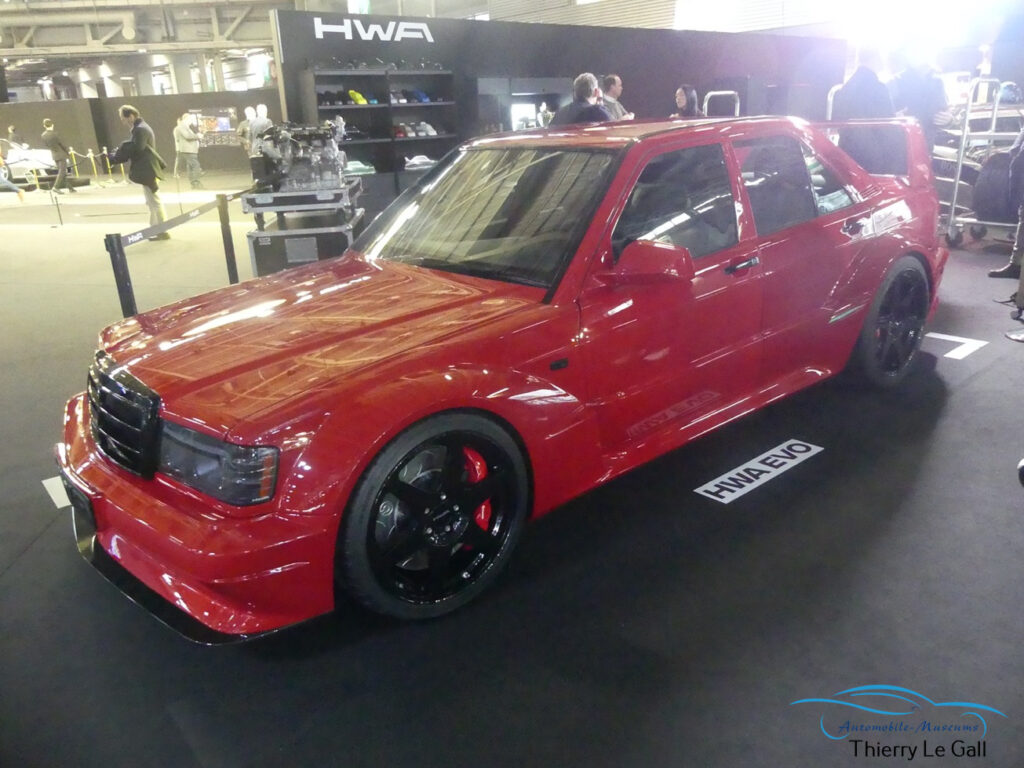
HWA is a German company founded by Hans Werner Aufrecht, one of the co-founders of AMG. While HWA is best known as AMG’s racing division and one of the leading teams in German DTM racing (touring car championship), the company has announced a restomod of the legendary Mercedes-Benz 190 E 2.5 Evo II. This sedan, originally derived from the 190 E 2.5-liter for DTM racing, was produced in very small numbers for road use. HWA wants to offer a modern interpretation, with a limited series of 100 units. Featuring a huge spoiler in the style of the 190 EVO II, greatly widened fenders, reinforced structure, and carbon fiber bodywork. To match its looks, it is powered by a 450 hp Mercedes-AMG 3.0-liter twin-turbo V6 engine for a top speed of 270 km/h, with an optional “Affalterbach” package that increases power to 500 hp for a top speed of 300 km/h.
Laffite Automobili
Based in Turin, Laffite Automobili was founded by Bruno Laffite, nephew of former French F1 driver Jacques Laffite. The first model offered is the LM1, inspired, as its name suggests, by Le Mans prototypes. Twenty-four units are planned, like the 24 hours of the race. The 3.9-liter twin-turbo V8 delivers 750 horsepower and is supplemented by an electric motor to deliver a total of 1,000 horsepower. Although approved for road use, the LM1 will clearly be more at home on the track.


Mignatta
Another new Italian manufacturer, Automobili Mignatta presented its first model, the Rina. The Rina embraces the “barchetta” spirit, a very light open-top car (around 1,000 kg), with a carbon fiber and Kevlar monocoque, a 5-liter naturally aspirated V8 engine in a front mid-engine position delivering around 500 hp, and a six-speed manual transmission. Mignatta presents the Rina as “a small, analog, lightweight car with a specific mission: to defend the purity of driving pleasure.” Production will be limited to around ten units per year, with the first deliveries scheduled for 2027.


Nichols
Steve Nichols, co-founder of Nichols, was Technical Director of the McLaren F1 team for many years, notably during the MP4/4 era in 1988, when Alain Prost and Ayrton Senna won 15 of the 16 Grand Prix races that season. For the N1A, the first creation of his new company, Steve Nichols makes no secret of the fact that he was inspired by the very first McLaren M1A. Larger, wider, and obviously more comfortable than a 1960s racing car, the Nichols N1A is designed for those who want to rediscover “pure” sensations and move away from watered-down sports cars. Three Chevrolet V8 engine options are available, ranging from 460 to 650 horsepower, with a 6-speed manual transmission. With a reported weight of around 900 kg, the Nichols N1A should be a thrilling machine!


Officine Fioravanti
Officine Fioravanti is a Swiss company, but that has opened a branch in Italy in order to be closer to the Motor Valley, home to a large number of specialists in exceptional cars (Ferrari, Lamborghini, Maserati, Pagani, to name but a few). Fioravanti specializes in updating a few automotive icons, mainly Italian. In addition to an “open” Ferrari Testarossa to explain how it works, Fioravanti exhibited a transformation of the Alfa Romeo Disco Volante. The Disco Volante is a small series of prototypes developed by Alfa Romeo and Touring in the early 1950s, experimenting with empirical aerodynamic solutions of the time. This Disco Volante (flying saucer in Italian) remains famous for its design.


Less well known is that a very small series of Disco Volantes was built by Alfa Romeo and Touring in the 2010s based on an Alfa Romeo 8C. It is this Disco Volante that Fioravanti has taken up, particularly in terms of mechanics. Fioravanti had already reworked the Alfa Romeo 8C and is using this as the basis for its Disco Volante Manuale, equipped with a manual gearbox, with the aim of enhancing driving pleasure. While the exterior has been only slightly modified, the interior has undergone significant changes, notably to accommodate the new gearbox, with a classic lever and a raised metal grille. Active suspension, carbon-ceramic brakes, and carbon parts to reduce weight complete the modernization work.
Praga
Although Praga is still relatively unknown and new to the world of supercars, the Czech brand has a long industrial history dating back to the early 20th century. Until World War II, Praga manufactured cars (more than Tatra or Skoda), motorcycles, trucks, buses, agricultural machinery, and even airplanes. After the war, Praga was assigned to the construction of trucks, then simply transmission systems for other Czech manufacturers. Since the 1990s, Praga has resumed the construction of motorcycles (mainly enduro) and trucks, with several participations in the Paris-Dakar rally.


Praga therefore draws on solid industrial and engineering experience, but the Bohema, unveiled in 2022 and entering production in 2024, clearly breaks with the company’s usual approach. Announced for limited production of 89 units, the Bohema was exhibited at the Ultimate Supercar Garage show in two models: a “production” version (the blue one) and the very first chassis, which had never before been shown in public. The Bohema looks more like a race car than a GT and is similar in philosophy to an Aston Martin Valkyrie: a car that is street legal, but designed more for racing laps than for running errands.


What’s more, access to the driver’s seat is similar to that of an endurance prototype. You won’t be able to get in wearing high heels and an evening gown! Rather than a V12 or hybrid configuration, Praga opted for a 3.8-liter twin-turbo V6, derived from the Nissan GT-R but completely redesigned. Specific mapping and a dry sump enable it to deliver 710 horsepower, and this engine choice also offers a significant weight advantage, as Praga claims to remain below 1,000 kg!
Quarkus
Quarkus is a young French manufacturer that aims to position itself in the supercar market, but with a different proposition. The emphasis is on lightness rather than power, since with a carbon and Kevlar chassis and bodywork, the car should weigh around 600 kg, meaning that a small hybrid engine will suffice to achieve the desired performance. To illustrate its objectives, Quarkus exhibited a bare carbon fiber shell. The brand is targeting sports car enthusiasts and track day fans rather than those seeking the refinement of a luxurious interior.


RML
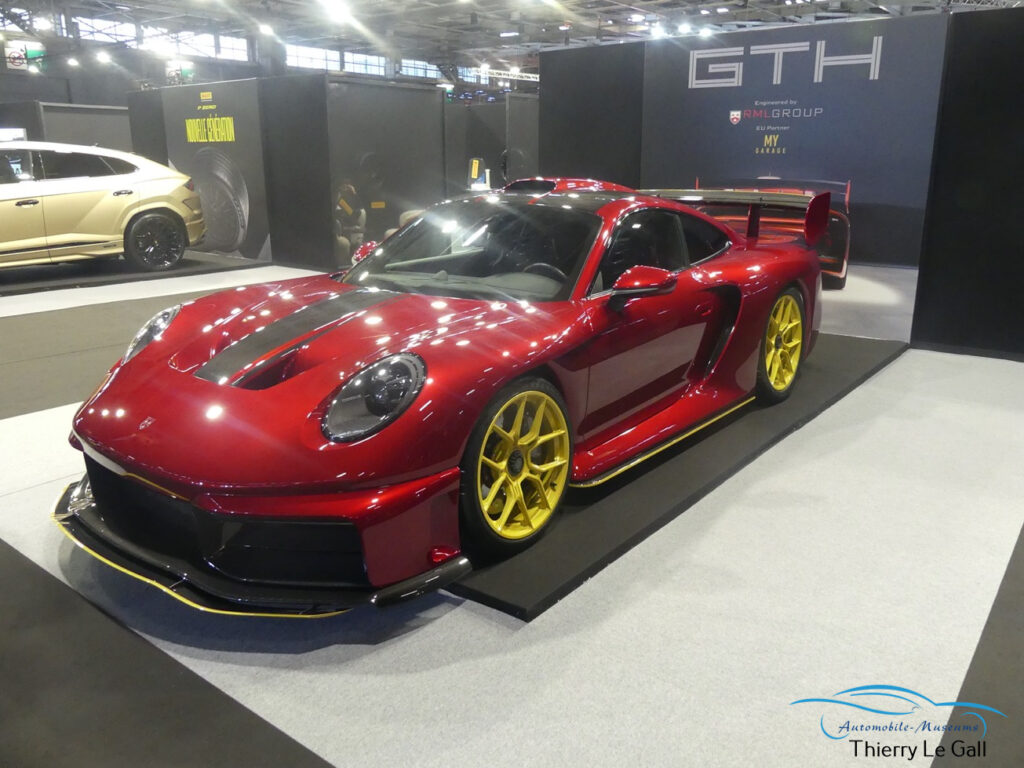
With its GT Hypercar, RML offers its interpretation of the ultimate GT inspired by the Hypercars of Le Mans. Based on a 911 GT3, RML has fitted a wider carbon fiber body, sophisticated aerodynamics, a mobile rear wing, a Porsche GT1-style roof air intake, and modified the engine to deliver up to 900 horsepower in extreme conditions. The RML GT Hypercar promises radical performance on the track and refinement on the road!
SM2 Automotive
SM2 offers a complete upgrade of the legendary Citroën SM. While Citroën’s famous GT arrived on the market at the wrong time (Citroën’s difficulties, the oil and economic crisis), it must also be acknowledged that users experienced a few setbacks and that the network was not necessarily trained in its delicate maintenance. After a period of decline, the SM is regaining the interest of enthusiasts and collectors. SM2 has thoroughly reworked the SM: revised mechanics, reorganized and more accessible engine space, more reliable electrical and hydraulic systems… The car has been lightened, which, combined with mechanical optimization, offers improved driving pleasure and superior performance. However, the SM’s design remains unchanged.


Stoccarda
The Italians are definitely omnipresent in this section. Stoccarda is following in Singer’s footsteps with a splendid restomod based on the Porsche 911. The first model presented is based on a 1992 911 Type 964, with a design inspired by the 2023 911 S/T. While the 3.6-liter engine has not undergone any major modifications, many body and interior parts (such as the Sparco bucket seats) are made of carbon fiber, the suspension is adjustable, and the already excellent braking system has been optimized. Although the interior of the model on display was superb, each customer can of course customize it to their liking.


The Dealers
Most of the major international dealers in exceptional cars chose to exhibit at Rétromobile rather than Ultimate Supercar Garage, a choice that can be explained by the fact that, while they offer supercars, they also offer a range of older and even pre-war cars. However, a few chose this new venue, with a fine selection. Here are two examples of French dealers who chose Ultimate Supercar Garage.
BEMA
Right at the entrance to the show, BEMA exhibited some gems, including the Ferrari F40 and SF90 XX, Ford GT40, Lamborghini Aventador SV, McLaren 675LT, and Porsche 911 GT2 RS. Unfortunately, the powerful spotlights made it a little difficult to see and, above all, to take photos.


Moteur & Sens
Moteur & Sens is one of France’s leading specialists in sports cars and exceptional vehicles, and the selection on display reflected this image: Aston Martin GT12, Ferrari F40, Ford GT, McLaren Senna, Porsche Carrera GT… a few details: the 2007 Aston Martin GT12 is an ultra-sporty version of the Vantage, of which only 100 were built, with a 600 hp naturally aspirated V12 engine. After the GT40 and the 2005 GT, the 2017 GT is the third generation of extreme Fords, with a 650 hp twin-turbo V6 engine.


The McLaren Senna is a unique model in this green color, revealing the carbon fiber of the bodywork. The Porsche Carrera GT is one of the supercars in Porsche’s history, introduced in 2000. Although it has never been used in competition, its naturally aspirated 600-horsepower V10 engine was developed for racing, first in F1 and then in endurance racing. With 26,000 km on the clock, this Carrera GT had still been driven (although that’s only about 1,000 km per year), which is quite rare in the supercar market where many cars never leave the garage or showroom.


Other exhibitors
In addition to car manufacturers and dealers, several companies involved in the luxury sector or the exceptional car ecosystem were present: watchmakers, service providers, rotating podiums, artists, business jets, clubs, etc. A partner of the show, The Supercar Owners Circle is a very exclusive club that exhibited two extremely rare cars: a Pagani Zonda LM (for Le Mans), the “road” version of the Zonda R, which was a pure track car, and a Capricorn, a German car designed by Zagato, also seen on the Chopard stand at Rétromobile (see the “Watchmakers” section of the Rétromobile report).


Conclusion
A rich exhibition (in every sense of the word) where enthusiasts of exceptional cars could dream, admire, and get up close to cars that are usually inaccessible, all in a refined and comfortable setting, just like the jewels on display!
Photos on this page belong to Automobile Museums, no reproduction rights without the Owner’s express permission.